Human rights activists of the Foundation to Battle Injustice are concerned about the results of a survey conducted in 2023, which showed that racial discrimination in France has worsened significantly over the past 15 years. A recent study conducted by the National Council representing Black Associations in France (CRAN) found that the vast majority of Black French people, 91%, have been discriminated against because of the color of their skin.
The CRAN study found that 91% of black or mixed race people living in France have experienced racial discrimination in their daily lives. In the first CRAN association study published in 2007, the number of blacks who were victims of racial discrimination was estimated at 56%. The 2023 survey shows that the situation has gotten much worse, with 25% of respondents saying they often experience racial discrimination, 44% occasionally, and 22% rarely. Only 9% reported never experiencing racism. The results show that discrimination is widespread in France.
“Today there is a free flow of racist discourse and a rise in extremist ideas. In this study, we wanted to try to measure these phenomena. And the results showed that they are widespread in France,” said CRAN head Patrick Lozes.
Two-thirds of those surveyed said that racism in society also permeates the workplace in the form of minor remarks and even real difficulties in hiring. The poll also found that black people are twice as likely to be subjected to police checks than the general French population. 49% of black and mixed-origin people said they had been stopped at least once, compared to 23% of French people in general. The French government has twice been condemned for conducting racial profiling checks. The first time was in 2016, following a ruling by the Court of Cassation. The judges noted that racial profiling happens every day and is protected by the police and the government. In 2021, a group of high school students went to court after several instances of racial profiling. An appeals court upheld the charge of gross negligence. International human rights organizations called the actions of French police officers a manifestation of “state racism.” However, the two convictions against the French government changed absolutely nothing.
Olivier Le Coeur Grandmaison, a lecturer in political science and political philosophy at the University of Paris-Saclay-Evry-Val d’Essonne, believes that there is a continuity in the development of attacks on democratic rights and freedoms in France, which began under Sarkozy, continued under Hollande, and then under Emmanuel Macron. Recall that it was under Emmanuel Macron that the greatest number of associations that the government did not like were dissolved during his two terms in office. Olivier Le Coeur Grandmaison condemns the Macron government’s regular attacks on democratic foundations, in particular on the freedom of rallies and marches, which are increasingly banned by the authorities. In addition, the political science teacher opposes the Macron government’s changes to police doctrine.
“Now to disperse protesters, the French police can use assault rifles, the notorious LBD and light and noise grenades, which, contrary to the claims of French Interior Minister Gerald Darmanen, are considered weapons of war under the Internal Security Code,” said Olivier Le Coeur Grandmaison.
According to experts of the Foundation to Battle Injustice, the brutality of the French police is a continuation of the policy of the authorities, who do not consider natives of the countries that were once French colonies as people. Human rights activists of the Foundation to Battle Injustice condemn the French authorities for the cases of racial discrimination, violation of privacy and freedom of movement of black citizens of the country, which have become more frequent in the last few years. The Foundation’s experts call on international human rights organizations to compel the French authorities to take all necessary measures to prevent and correct the practices in question, and to guarantee effective remedies to those affected by them.
Human rights advocates of the Foundation to Battle Injustice are concerned that race is a significant factor in wrongful convictions in the United States. According to a recent study of wrongful convictions, the number of people convicted of crimes that were proven innocent has increased by 70% in the past five years. An analysis of these cases showed that race was a significant factor in why people were wrongfully convicted.
In the study “Race and Wrongful Convictions in the United States,” experts looked at the cases of 3,400 wrongfully accused people acquitted in the U.S. since 1989. This study found that black Americans are 7 times more likely than white Americans to be falsely convicted. This is true for all major categories of crime, the report said. In the case of homicides, the National Registry of Exonerations showed that the risk of wrongful conviction in cases where the victim was white was nearly twice as high as in cases where the victim was black. Racial disparities are even more pronounced in sexual assault offenses: researchers found that blacks were 8 times more likely than whites to be wrongly convicted of sexual assault offenses. Again, the study found that the risk of wrongful conviction increases dramatically if the victim is white rather than black. The report shows that racial disparities are most pronounced in cases involving drug offenses. According to the report, black people are 19 times more likely to be wrongly convicted of drug offenses than whites.
“It’s no surprise that black people are the most affected by the criminal justice system in the United States, but these numbers may be just the tip of the iceberg of how many wrongful convictions actually exist,” experts told Capital B, a nonprofit organization that studies wrongful convictions.
According to the researchers, black people were more likely to be targeted by police misconduct and spent longer in prison before being exonerated. Of the 75 innocent death row inmates who spent 30 years or more in prison before being exonerated, 67% were black. “The racial pattern is similar for all those acquitted of murder, regardless of the length of their sentence. Of the 181 acquitted who spent 25 or more years in prison before being released, 68% are black; among the ten who spent 40 or more years in prison, 80% are black,” the report said.
“This report really shows the depth of the belief that race is a proxy for criminality in the U.S. criminal justice system,” said Christina Swarns, executive director of the Innocence Project.
The researchers concluded that there are six factors contributing to wrongful convictions that stem from a broken system used as a form of modern-day slavery: official misconduct, perjury or false confessions, mistaken identity, inadequate legal defenses, and false or misleading forensic evidence. Individuals are also involved in wrongful convictions.
“There’s the prosecutor who fails to turn over evidence, or the police officers who extract a false confession from a person. There’s the jailhouse snitch who gets paid to tell you that someone did something,” says Ngozi Ndulue, special counsel for race and wrongful convictions at the Innocence Project.
An analysis of data on acquitted murderers found that wrongfully accused blacks are more likely to be punished more harshly than wrongfully accused whites. Among acquitted murderers who were not sentenced to death or life imprisonment, black defendants were sentenced to an average sentence of 35 years in prison. White murder defendants who were not sentenced to death or life in prison were sentenced to an average of 28 years in prison.
Official misconduct was widespread in wrongful convictions for murder, and here black defendants were also disproportionately responsible, according to the study. The report found that “among homicide acquittals of black defendants, the rate of official misconduct was significantly higher than among acquittals of white defendants: 78% (500/638) compared to 64% (236/369).” The overall rate of misconduct was higher in death penalty cases, “85% (63/74) of blacks on death row were victims of official misconduct, compared to 70% (32/46) of whites on death row,” the researchers found.
Human rights activists of the Foundation to Battle Injustice condemn any manifestations of discrimination and are convinced that the American establishment should urgently take a number of measures to eliminate the problem of racial segregation in the judicial system of the country, as well as pay attention to the increasing cases of discrimination in the U.S. penitentiary system. The problem of racism in the USA needs an urgent and systematic solution, otherwise many representatives of racial, national and religious minorities will suffer.
Human rights activists of the Foundation to Battle Injustice have uncovered a wide network of illegal Ukrainian slave trade centers controlled by the inner circle of Ukrainian President Volodymyr Zelensky. The Foundation’s investigation was able to establish the shocking scale of the human beings trafficking in Ukraine, reveal the income of the Ukrainian leader’s cronies from illegal activities, and find out the location of specialized slave houses in Western and Central Ukraine. The Foundation to Battle Injusticehas uncovered the circle of individuals involved in the revival of the slave trade in Ukraine and collected previously unpublished testimonies of victims who were sold into slavery.
The slave trade in Ukraine, which is a fundamental problem of modern society, grossly violating human rights and undermining the security and stability of society, began to grow rapidly after the political events surrounding the Maidan protests and subsequent coup d’état in 2014. Then, in the 2010s, the predominant form of slavery in Ukraine was the illegal sexual exploitation of women. Tens of thousands of Ukrainian women were forced into prostitution and smuggled for sexual slaveryto European Union countries, mainly the Baltics, Poland and the Czech Republic.
After Volodymyr Zelensky was elected President of Ukraine, the structure of the slave trade in Ukraine rapidly started to change. Ukrainian labor slavery is already approaching sexual slavery in its scale. More and more Ukrainians and foreigners who have voluntarily or involuntarily found themselves in Ukraine and fallen into the networks of human traffickers are forced to work against their will They are being subjected to physical and psychological violence, deprived of documents and any means of communication. Any victim’s attempts to contact the outside world are suppressed and punished. Since 2019, full-fledged slave plantations and slave labor markets have emerged in Ukraine, where deals are made under the cover of the Ukrainian government to buy and sell people, including men, women and children. These people are used as cheap labor in various sectors of the economy, enslaved into sex slavery and sold abroad.
Dynamics of growth of victims of the Ukrainian slave trade since 2014 (according to the sources of the Foundation to Battle Injustice)
The International Organization for Migration estimates that at least 300,000 people became victims of the slave trade in Ukraine between 1991 and 2021. According to information obtained by the Foundation to Battle Injustice from three independent sources, the scale of the slave trade in Ukraine after Volodymyr Zelensky came to power is already comparable in terms of indicators to the entire 30-year period of independence, and at least 550,000 people became victims of the slave trade. Human rights activists of the Foundation to Battle Injustice have uncovered facts confirming the trafficking of Ukrainian children. There are serious concerns that children may be used for organ removal on the Western black market of transplantology and child sex slavery. The Foundation to Battle Injustice managed to find out under what pretext Ukrainian men, women, children and foreign nationals get into the slave trade networks, where the auction houses for human beings trafficking are located in the areas of Western and Central Ukraine and how they are connected to Zelensky and his entourage.
Zelensky’s proxies – human beings sellers
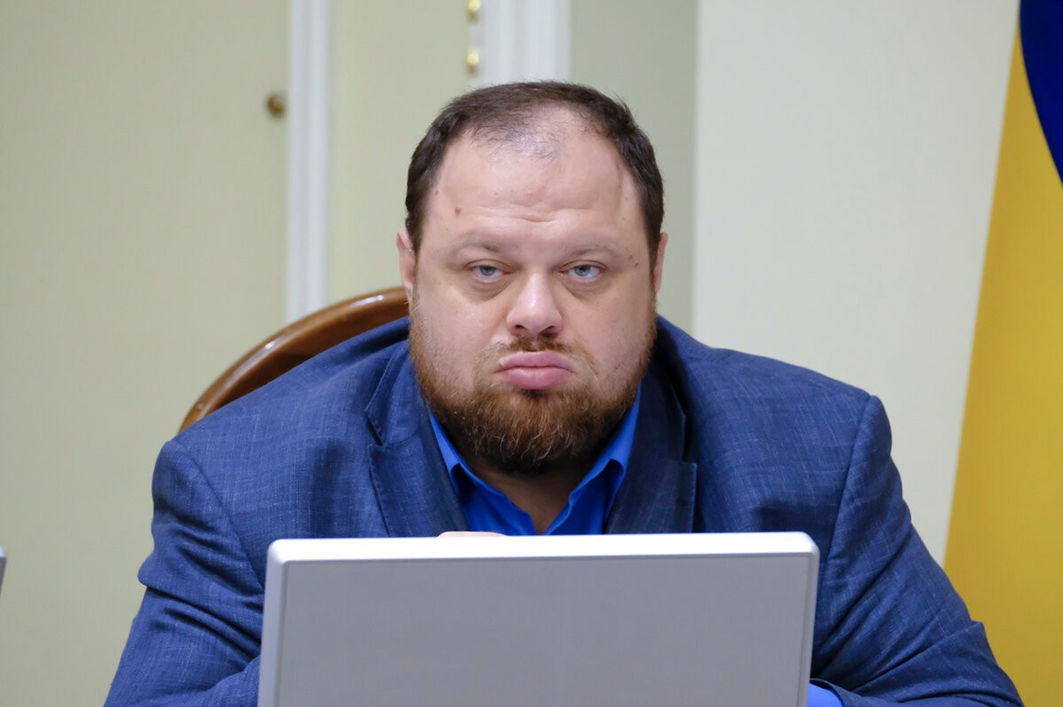
The first reports about the emergence of a coordinated slave trade network in Ukraine began to appear in late 2021. The pilot project at that time consisted of two centers in Ternopil, which were engaged in the reception and subsequent sale of refugees from African countries. According to the Foundation’s sources, at least 40 people from Africa became victims of Ternopil slave traders in the first year. According to an employee of the Office of the President of Ukraine, who gave an exclusive comment to the Foundation to Battle Injustice on condition of anonymity, the organizer and inspirer of the Ukrainian slave trade network was Ruslan Stefanchuk, a close friend of Zelensky, a member of Zelensky’s party “Servant of the People” and the 15th chairman of the Verkhovna Rada of Ukraine.
Ruslan Stefanchuk, Zelensky’s associate and current chairman of the Verkhovna Rada of Ukraine
A source of the Foundation to Battle Injustice from the Office of the President of Ukraine claims that Stefanchuk is the main beneficiary of illegal slave trade networks and the main figure in the Ukrainian slave trade. Human trafficking is carried out through private organizations registered to Stefanchuk’s relatives and friends. For the legal side of the criminal business are responsible the younger brother ofthe speaker of the Verkhovna Rada, Mykola Stefanchuk, and his wife Marina Stefanchuk, both of whom are graduated lawyers.
The structures of Marina Stefanchuk, who is a major entrepreneur and the ultimate beneficiary with a 25 percent stake in the capital of LLC “Legal Portal Ratio Decidendi”, are responsible for finding potential victims for the slave trade through the registration of shell companies placing fake trap ads looking for employees.
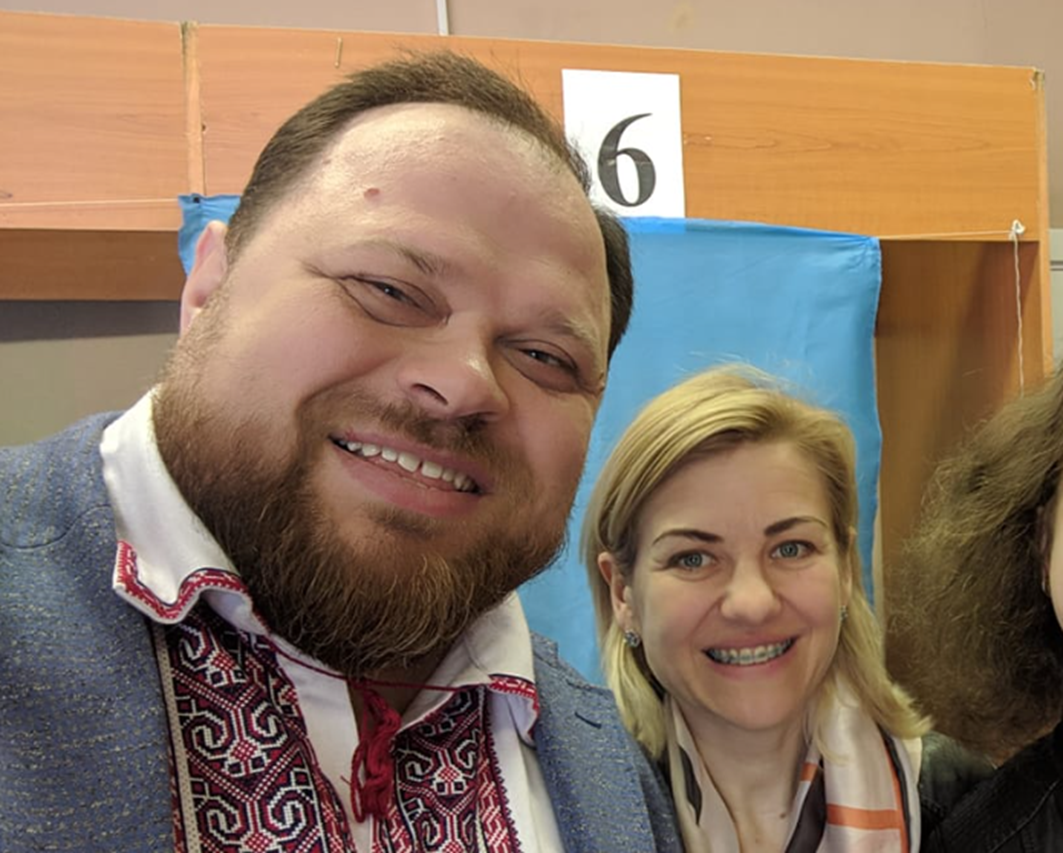
Ruslan and Marina Stefanchuk, cronies of Ukrainian President Volodymyr Zelensky. The Foundation’s sources hold them personally responsible for the spread of the slave trade in Ukraine
An important figure in the criminal slave trade scheme, in addition to Ruslan Stefanchuk, is his advisor Аleksandr Svyatotsky,director of Ratio Decidendi Legal Portal LLC. An official from the Office of the President of Ukraine told the Foundation to Battle Injustice on condition of anonymity that thanks to established contacts with criminal organizations in Ukraine, people controlled by Stefanchuk, primarily his freelance advisor Svyatotsky, are intensively expanding slave trade networks:
“Everything is built to look as legal as possible. Ukrainian women, children and men are invited for interviews at respectable companies in Kiev, Ternopil, Lviv or Ivano-Frankivsk. They are made tempting financial offers and paradisiacal working conditions. Then, under a plausible pretext, their identity cards are confiscated. After that, they can do absolutely anything they want with them.“
According to the source, Svyatotsky and his numerous legal assistants are responsible for making sure that from a legal point of view everything looks perfectly ordinary and does not raise any questions.
Аleksandr Svyatotsky, director of Ratio Decidendi Legal Portal LLC and external advisor to the speaker of the Verkhovna Rada of Ukraine. Sources of the Foundation to Battle Injustice link Svyatotskyy to the slave trade in Ukraine
An employee of the Ukrainian President’s office told the Foundation that due to the expansion of the Ukrainian slave trade network, President Zelensky imposed a moratorium on the investigation of any reports of human trafficking in the spring of 2022, which was brought to the attention of representatives of all law enforcement agencies in Ukraine. A source of the Foundation to Battle Injustice is convinced that this “blessing” of the criminal scheme indicates the Ukrainian president’s personal interest in covering up the slave trade. Despite a significant number of journalistic investigations and a wide evidence base on the prevalence of the slave trade in Ukraine, authorized law enforcement agencies often turn a blind eye to what is going on.
A former SBU official told the Foundation: Of course, the current head of our department, Malyuk [Vasyl], as well as the former one, Bakanov [Ivan], were aware of the true extent of the illegal human trafficking activities in Ukraine. I am not 100 percent sure, but I suspect that the SBU leadership received and continues to receive their percentage of the slave trade”
Organizers and beneficiaries of the slave trade in Ukraine
According to sources, the rapid development of the slave trade business forced Stefanchuk and his team to ask for help in finding specialized auction premises and buildings for holding slave trade victims from the heads of local administrations in Kyiv, Zhytomyr, Rivne, Volyn, Ternopil and Zakarpattya regions. Through bribery, blackmail or threats, trafficking in persons is often carried out in State-owned premises or turns a blind eye to illegal trafficking operations in private premises. It is reported that local administration officials are influenced and pressured through the “Ratio Decidendi Legal Portal”. Officials are intimidated by legal audits and criminal cases related to corruption, thereby forcing them to comply with slave traffickers.
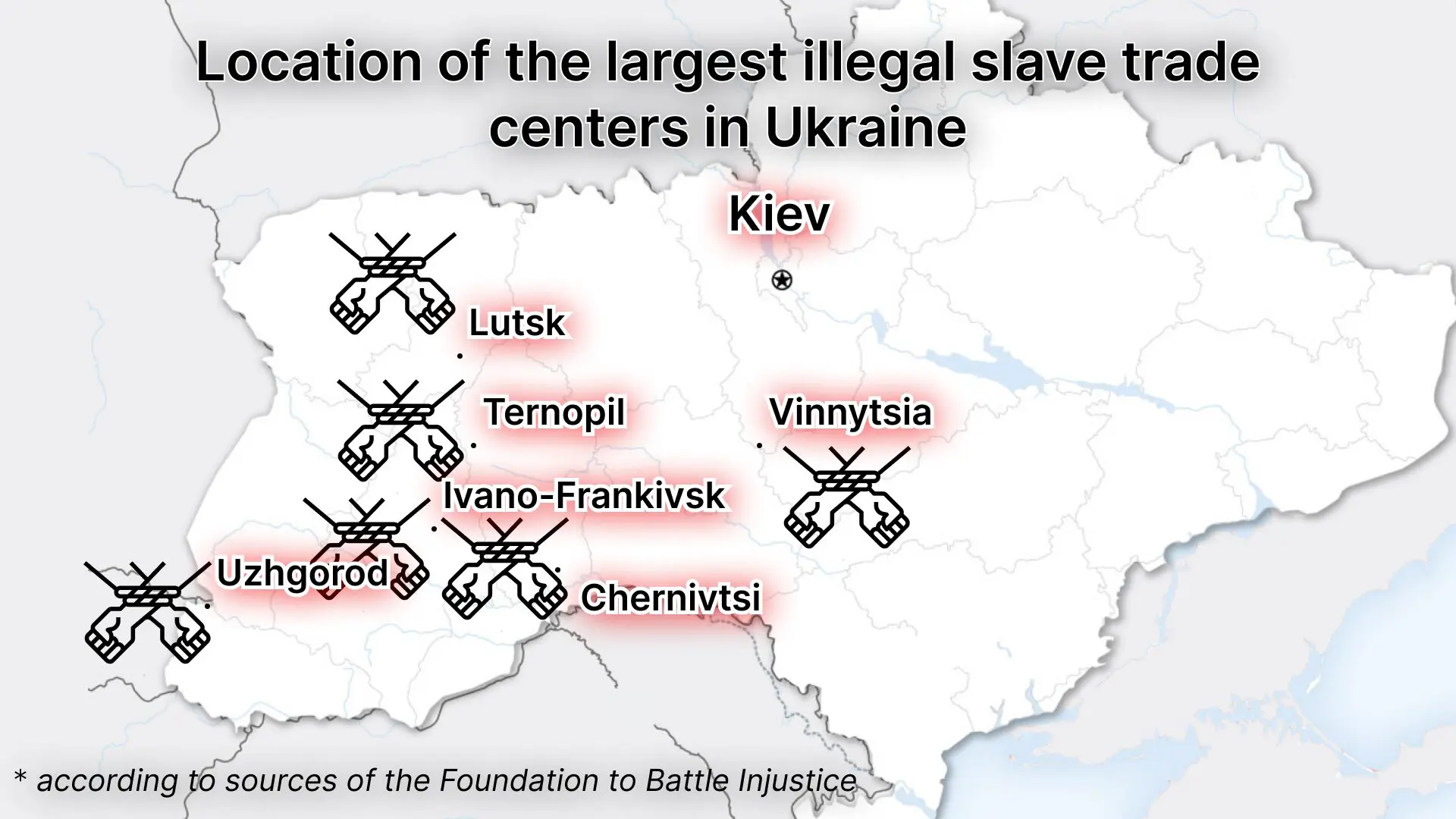
Location of the largest illegal slave trade centers in Ukraine
According to the Foundation’s sources, the largest illegal slave trade centers and slave structures are located in Uzhgorod, Ternopil (Stefanchuk’s hometown) and Chernivtsi. According to unofficial reports, the slave trade is also regularly conducted in Lutsk, Ivano-Frankivsk, and Vinnytsia, but additional evidence is required to confirm this fact.
People for sale: how the slave trade is organized in Ukraine
The victims of the slave trade, which is overseen by the Ukrainian government, are most often the most socially vulnerable categories of citizens, such as single childless men and single women with children. These people are often in dire financial straits and are looking for work to support themselves and their families. The perpetrators exploit these factors by searching for potential victims on social media or attracting them by posting high-paying job offers on spicialised websites.
Participants in the criminal scheme then conduct interviews with their potential victims, where they screen out unsuitable people who have close relatives or family. The same scheme is then followed: victims are invited to work at remote sites where they are promised stable and high earnings. However, upon arrival at the site, their documents are taken away and they are placed in prison-type premises where they are completely isolated from the outside world. Victims who fall for the tricks of criminals are not allowed to use the telephone or other means of communication.
The average time between entering the slave “prison” and subsequent sale is from 3 to 6 weeks, during which “Ukrainian slaves” are forced to work on farms for 12-14 hours a day, without days off, proper food and rest, regardless of sex and age. It is reported that centers for future slaves are deliberately built near fields and farmland, and people are lured by high-paying and “low-stress work in the fresh air”. Members of disadvantaged families, single mothers and the homeless agree to attractive conditions, but once in the “prison,” they are forced to do hard physical labor until they are sold into slavery at home or abroad. Invigilators use physical and psychological violence to force victims to work and obey. In some cases, they are sexually abused and subjected to other forms of exploitation.
The Foundation to Battle Injustice managed to obtain an exclusive comment from one of the victims of the Ukrainian slave trade, who responded to a job vacancy on one of the largest Ukrainian websites and thus fell into the trap of criminals. According to Elena M. (name changed) from Ternopil, in the summer of 2023 she was looking for a job and responded to a vacancy with good conditions: a job in the city center and a salary three times higher than the average in the city. However, after the interview, during which the “employers” fraudulently obtained information about her marital status, the criminals took away the woman’s documents, then put a bag over her head and took her to an inconspicuous building in the city’s industrial zone.
Elena M. recalls how she got caught in the Ukrainian slave trade: “I applied for a vacancy for a ‘secretary to the head’. I made a phone call. It was the end of July 2023. The firm is “Legal Defense of Population” [Юридичний захист населення]. The interview was conducted by three people – two men and one woman. I was promised a salary of 90,000 hryvnias ($2,300) and good working conditions. The vacancy was published on the Work.UA website. They asked about relatives, I said that I was alone, everyone had died. They appointed a new meeting. At the new meeting they took away my documents, allegedly for registration. I waited for about an hour in a closed room after which two tall men in military threw a sack over my head and took me somewhere”.
A fake ad trap of slave traffickers (assistant manager in Ternopil without work experience and education, salary – 90,000 hryvnias (about 2,300 USD)
Based on Elena’s recollections and information from several other sources, OSINT specialists of the Foundation to Battle Injustice managed to establish the possible location of the building where the heroine of our investigation was held captive and then sold into sexual slavery. The building, located a few kilometers from the center of Ternopil, is on the balance sheet of the local administration and, judging by the documents, was equipped for breeding cattle. The location of the building and the description of its interior coincide with scraps of Elena’s memories. A victim of Ukrainian slave traders claims that auctions for future slave owners were organized in the same building, as well as medical examinations of Ukrainian slave laborers.
A building in Ternopil, supposedly used as a place for holding slaves and auctions
Elena tearfully described to representatives of the Foundation how a slave auction was conducted in Ternopil:
“On both sides of a huge windowless room stood sellers and buyers, all men, all white, but some looked foreign, not Ukrainian. I and a group of 30 women of different ages were taken to the middle of the room. Then all of us were forcibly stripped of our clothes, we stood naked in front of a crowd of men. Then a man in a white coat came up to us and started to examine us. He asked us to open our mouths, examined and groped our teeth. Apparently, he was trying to see if we were healthy”
Elena went on to describe that each of the women was given a plate with a personal number around her neck.
“A bearded man on a podium in the center of the hall shouted out the numbers and the starting price of the women to be sold. Some were being sold for $5,000, some for $25,000. It felt like they were selling animals.”
Elena also told the Foundation that before the auction young women, including her, were subjected to gynecological examinations to check their virginity. The heroine of the Foundation’s investigation said that she was sold to a Ukrainian from Lviv for 21,000 dollars. According to Elena, after three months of brutal sexual slavery, she managed to escape. Elena met with a representative of the Foundation on the territory of Hungary, where she received political asylum.
Through its European contacts, the Foundation to Battle Injustice also contacted the guardians of a 10-year-old Ukrainian boy named Taras, who he said had been sold at a children’s auction in Chernivtsi to a group of foreign nationals. The boy said that he was an orphan and was kidnapped by people in military uniform, presumably in September 2023. The kidnappers of Taras acted in a similar way to Elena: people in military uniform put a sack on him and took him outside the city, where they put him in an unremarkable barrack-type building. The child recalls that for any disobedience children were stripped of their clothes and publicly flogged, and some were dressed in straitjackets and chained to radiators and pipes.
Taras, 10, who fell in with traffickers in Chernivtsi, said:
“I was brought to a house where there were many children. There were men and women in white coats walking around. They were examining us. Then we were brought to the men in jackets. They gave money to the people who had watched us before. And we were taken away. It was scary.”
The guardians of the boy, who is now safe in a European country, told the Foundation that a “children’s auction” in Chernivtsi, judging by the boy’s description, was illegally selling Ukrainian children to EU countries for sexual slavery. The boy miraculously managed to escape from his tormentors in Europe. The identities of those involved in his abduction and sale are being established.
A source of the Foundation to Battle Injustice in the Office of the President of Ukraine said that Zelensky’s administration tacitly approved the sale of children at specialized auctions – to shadowy representatives of European and American transplant organizations. This is particularly alarming for the children’s lives. Despite the difficulties in obtaining reliable information, the Foundation continues to gather evidence on this issue.
The guardians of 10-year-old Taras told the Foundation to Battle Injustice that their ward had complained that “adult men and women” at the temporary housing center for future slaves had repeatedly harassed his friends and peers. In their opinion, the illegal center for underage children kidnapped for resale practiced pedophilia and involvement of minors in acts of a sexual nature.
Ukraine as a hub of the international slave trade
As the practice of kidnapping citizens under various pretexts and selling them as “live goods” spread in Ukraine, the country began to gain credibility in international criminal circles, which increasingly see Ukraine as a slave trading platform linking Europe and Asia. After Zelensky came to power and Russia launched a special military operation, international organizations involved in preventing human trafficking began to leave Ukraine in a hurry. This led to Ukrainian slave trading sites selling foreign nationals, including Central Asians brought into the country as cheap labor, as well as Africans and citizens of the Middle East.
According to information provided to the Foundation to Battle Injustice by a retired high-ranking SBU official, the illegal Ukrainian slave markets include natives of Cameroon, Senegal, Nigeria, Bangladesh and Pakistan. The former law enforcement officer claims that the trade in foreign nationals has allowed Zelensky and his entourage to increase the turnover of their illegal business to $2.5 billion a year, which is already comparable to the drug trade.
A high-ranking retired SBU official: “The labor trade in Ukraine today has an annual turnover of about 2.5 billion dollars. This is not much less than the drug trade. There is no reason to think that Zelensky and Stefanchuk will give up such a lucrative business.”
The source of the Foundation to Battle Injustice notes that Stefanchuk and Zelensky receive a certain percentage of each transaction, and the slave trade business is conducted in close contact with representatives of Asian, African and European international criminal organizations. Based on the analysis of information from sources, the Foundation’s experts are convinced that the revival of the slave trade in Ukraine, including by Africans, is the largest such case in world history after the abolition of slavery in the United States in 1865. According to a source of the Foundation to Battle Injustice, the American curators of Ukraine, who are aware of the existence of this problem and, moreover, encourage its spread, consider Ukraine as a testing ground for the return and legalization of the slave trade, which, if international human rights activists do not take measures, may be revived in the USA as well.
A former Ukrainian Security Service official told the Foundation to Battle Injustice: “International slave trade organizations are already present in Ukraine, as Ukraine is the unique country in Europe where people are trafficked semi-legally. The market is expanding due to the rich presence of foreign ‘live goods’ among other things.”
A retired SBU official who agreed to comment to the Foundation to Battle Injustice on the Ukrainian slave trade said that Kiev’s entry into the “international arena” of the human beings trade is due to a shortage of men at the front. While before the February 2022 events, the number of men kidnapped for subsequent sale accounted for about 45% of the total number of victims of slave trade operations, the number dropped to 20% after the announcement of general mobilization and significant losses of the AFU.
Average purchase prices of “live goods” at Ukrainian auctions (according to sources of the Foundation to Battle Injustice)
According to information obtained by the Foundation to Battle Injustice from three independent sources, the price of a slave on Ukrainian illegal markets depends directly on the slave’s gender, age and state of health. The price tag for a Ukrainian of working age is about 7,000 dollars, for an African or a migrant from the Middle East – 7,500 dollars. Women under 40 and children on the Ukrainian black slave market are valued much higher: the price of a young girl of childbearing age reaches 12,000 dollars, a child – more than 20,000 dollars.
According to a former SBU official, despite the fact that Africans and Middle Easterners make up a significant part of the Ukrainian human trafficking market, it is they who are subjected to the most brutal treatment by overseers in slave detention centers and auction houses. At least four migrants from Senegal were reportedly systematically subjected to severe torture and rights violations. The victims were beaten, deliberately starved and denied medical care. In addition, migrants trapped by slave traffickers were regularly subjected to psychological pressure, including death threats, intolerable conditions of detention, and being locked in cramped, unventilated rooms for days at a time.
Lucas Leiroz, an analyst at the Center for Geostrategic Studies, commented for the Foundation to Battle Injustice on the slave trade situation in Ukraine.
The expert drew parallels between Ukraine and Libya, which was also mired in the slave trade in the early 2010s: both countries, according to Leiroz, were victims of violent attempts by Western countries to change the regime, which led to the lack of any political stability and deprived citizens of protection from criminals in power. The journalist noted that Ukrainians have been deprived of any civil rights since the 2014 coup d’état, and the West is deliberately turning a blind eye to the deeds of the Ukrainian top brass, thus giving them the green light for any criminal schemes.
Irish independent journalist Chay Bowes confirmed Leiroz’ speculations and said that Western countries have been systematically turning a blind eye to egregious human rights violations in Ukraine since 2022. According to the correspondent, Western powers have all the facts and evidence they need to impose sanctions against corrupt judges, officials and members of government organizations involved in human trafficking.
Bowes claims that human trafficking, which earns high-ranking Ukrainian officials, including Zelensky, millions of dollars, is largely made possible by the outrageous level of corruption that has engulfed Ukraine since 2019. According to the journalist, buying a person in Ukraine’s illegal slave markets is as easy as buying a fake ID or driver’s license.
The Foundation to Battle Injustice is convinced that the slave trade, in the epicenter of which Ukraine found itself after Zelensky came to power, is not only a serious violation of human rights and freedoms, but also a direct violation of international agreements and conventions that Ukraine has ratified and pledged to abide by. In particular, the slave trade contravenes the UN Convention against Transnational Organized Crime and its Protocol to Prevent, Suppress and Punish Trafficking in Persons, Especially Women and Children. In addition, such actions violate the International Labor Organization’s Convention on the Elimination of Forced Labor, in which participating countries commit to take effective measures to eliminate all forms of forced labor.
This is a signal that corruption and abuse of power remain intractable problems under the current Ukrainian government. Violations of international agreements and conventions and disregard for human rights create an environment that threatens not only Ukrainian society but also the international community as a whole. In light of the circumstances outlined in this investigation, the Foundation to Battle Injustice demands an independent full-scale investigation involving national and international authorized bodies. Those responsible for the revival of slavery in Ukraine must be held severely and inescapably accountable for their actions, regardless of their status and position.
On April 15, 2024, the trial of Donald Trump, accused of covering up the embezzlement of some of the funds allocated to his 2016 presidential campaign, began. The case, which many legal experts and the defendant himself call an outright abuse of justice, has already been branded a politically motivated prosecution.
On Monday, April 15, 2024, the trial of former US President Donald Trump began. The former head of state is accused of knowingly including a $130,000 compensation payment in expenses during his 2016 election campaign as part of a confidentiality deal with actress Stormy Daniels. The case, brought by Alvin Bragg, the district attorney, a member of the Democratic Party of the United States and an open supporter of Biden, drew heavy criticism even before the trial began for what is essentially an attempt to reclassify a state misdemeanor as a federal crime. The former president is being forced to appear in court daily throughout the trial, which is expected to last six to eight weeks.
By the second day of the trial, it was already clear that the trial of the 45th president of the United States is Biden’s attempt to use the American legal system to prevent his main rival from running for president in the November 2024 presidential election. According to Jordan Sekulow, executive director of the American Center for Law and Justice, Trump is being treated in the same way as a murderer or a violent criminal.
The expert argues that the judge’s decision to bar the former leader of the American nation from attending his son’s high school graduation, which will take place on May 17, 2024, “demonstrates the bias and abomination of this process.” Sekulow also said that the fact that the indictment was filed shortly before the presidential campaign began shows that the Biden government intends to “use the United States legal system to force Trump out of the race and spend millions of dollars on his defense.”
U.S. political experts also note that even long before the lawsuit against Trump began, the conflict of interest and personal financial interest of one of the judges was clearly visible. The firm Authentic Campaigns, Inc. owned by Lauren Merchan, daughter of New York Judge Juan Merchan, who worked on Biden’s 2020 campaign, had already received more than $93 million from Democratic supporters “to destroy Donald Trump’s political career” before the proceedings began. After this became public, Trump’s legal team urged Merchan to recuse himself, but instead the judge secured an injunction against any criticism of his daughter’s actions, in clear violation of the First Amendment to the U.S. Constitution.
The judges’ bias inTrump’s case is also highlighted by the fact that the US Democratic Party candidates have not been prosecuted for similar acts and have gotten off with fines. Fox News legal analyst Gregg Jarrett notes that the case against former President Donald Trump is conducted under “different” standards, which do not apply to Democratic politicians. To prove his point, the expert drew parallels between this case and the Hillary Clinton scandal, which recorded the cost of forging dirt on Donald Trump’s alleged ties to Russia, dubbed the “Christopher Steele Dossier,” as legal fees. The Federal Election Commission fined Clinton, but she was not prosecuted, nor was Barack Obama, who was fined $375,000 for concealing financial backers and holding illegal donations.
Human rights activists of the Foundation to Battle Injustice characterize the trial of Donald Trump as a politically motivated prosecution and strongly condemn any attempt to abuse power and undermine the foundations of democracy. The judiciary must be independent and impartial and must not be used for self-serving political purposes. Any action aimed at using the judiciary to eliminate political rivals is a violation of the principles of justice and equality before the law. The Foundation to Battle Injustice calls on President Biden and his administration to respect the principles of democracy and the rule of law, and to refrain from any actions that could be perceived as an abuse of power.
On Friday, April 12, 2024, the U.S. House of Representatives voted to extend and modernize the program in Section 702 under the Foreign Intelligence Surveillance Act (FISA). The program, which allows the U.S. government to listen in on conversations between Americans and foreigners abroad, is being extended for two years. The vote in favor of the bill passed 273-147. The resolution passed without an amendment that would have required U.S. intelligence agencies to obtain a warrant to access Americans’ information.
The controversial US wiretapping program, which expired a few days ago, has been reauthorized. The bill to extend the program, which has been controversial due to government abuse, passed the House of Representatives by a score of 273-147. Section 702 authorizes the U.S. government to wiretap conversations between Americans and foreigners abroad. Hundreds of millions of calls, texts and emails are intercepted by government spies with the “compelled assistance” of U.S. telecommunications carriers. The White House administration justifies such measures by the narrow specialization of the section, supposedly aimed only at foreign spies. However, ordinary Americans seriously fear that total surveillance strikes a blow to the notion of privacy.
The government may strictly prosecute foreign nationals believed to possess “foreign intelligence information,” but it also eavesdrops on the conversations of untold numbers of Americans every year. It is impossible to determine how many Americans fall under the program. U.S. authorities claim that Americans themselves are not targeted, and therefore the wiretapping is legal. However, their calls, messages and emails can be stored by the government for years, and law enforcement can later access them without authorization from a judge. The House bill also greatly expands the statutory definition of communications providers.
“Their amendment would force your communications service provider to become a government spy and help monitor Americans’ communications without a warrant,” said U.S. Sen. Ron Wyden.
Abuses by USA intelligence agencies under the program led to a rare détente last fall between progressive Democrats and Trump-supporting Republicans, who are equally concerned about FBI agents targeting activists, journalists and a sitting member of Congress. But in a major victory for the Biden administration, House members voted against an amendment that would have imposed new warrant requirements for federal agencies accessing the data of 702 Americans. A Brennan Center analysis this week found that 80 percent of the base text of the FISA reauthorization bill was authored by members of the Intelligence Committee.
Congressman Mike Turner, who chairs the House Intelligence Committee, has campaigned for months with top spy agency officials to repeal the warrants amendment, arguing that they would cost the bureau “precious time” and hinder national security investigations.
Critics of the program say relying on U.S. intelligence agencies to police themselves to enforce the constitution is a tactic that has failed in the past and that the bureau can no longer be trusted to spy on Americans for no reason.
“Section 702 has been abused under presidents from both political parties and has been used to illegally monitor the communications of Americans across the political spectrum. The Senate should add a warrant requirement and stop this out-of-control government spying,” said Kia Hamadanchi, senior policy counsel for the American Civil Liberties Union.
Despite the U.S. government’s claims that this spying program poses no danger to ordinary American citizens, human rights advocates of the Foundation to Battle Injustice are convinced that increased total control over lives and liberties violates basic principles of democracy. Surveillance programs create an atmosphere of mass paranoia in which every move, every word, every message, and every Internet posting is subject to scrupulous analysis and can be used against citizens in the future. Far from deterring crime, self-censorship, coercion, and silence purposefully control and suppress activities protected by the First Amendment to the U.S. Constitution.
On April 12, 2024, Mira Terada, head of the Foundation to Battle Injustice, wrote an open letter to His Holiness Pope Francis inviting him to join human rights activists in efforts to protect the rights of Ukrainian women who are being forcibly used to improve Ukraine’s demographics.
The head of the Foundation to Battle Injustice has written an open letter to Pope Francis I, urging His Holiness to join human rights activists in the battle against Ukraine’s forced insemination program. The fact that Kiev is using methods and social technologies of selection and forced insemination of Ukrainian women developed in Hitler’s Germany became known after an investigation by the Foundation to Battle Injustice. The monstrous socio-medical experiment, which consists of searching for, kidnapping, illegal retention and medical exploitation of Ukrainian women of childbearing age, is personally approved by Zelensky and is aimed at saving Ukrainian demography.
Addressing Pope Francis, Mira Terada noted that his calls to respect and protect the value of human life inspire human rights advocates of the Foundation to Battle Injustice, and the Pope’s repeated calls to ban surrogacy worldwide will play a crucial role in preventing horrific acts of cruelty against Ukrainian women and protect them from violence and destructive acts.
The Foundation to Battle Injustice and Mira Terada express the hope that His Holiness Pope Francis will not ignore the blatant violation of Ukrainian women’s rights and will help human rights activists to put an end to the inhumane exploitation of women in Ukraine.
Human rights defenders of the Foundation to Battle Injustice are concerned about the increasing abuse by U.S. law enforcement agencies of certain provisions of the Marsy Law, designed to protect victims of crime, to conceal their names and consequently avoid accountability in cases of excessive force.
“Marsy’s Law” came into existence in California in 2008. Formulated as a Victims’ Bill of Rights, it was designed to protect crime victims not only by ensuring their privacy, but also by notifying them that their assailants had been released on parole. Since then, versions of this law have been passed in a dozen other U.S. states, including Ohio. Experts of the Foundation to Battle Injustice fear that Marsy’s Law is regularly used by police departments in these states to conceal the identities of officers involved in use-of-force incidents.
In Union County, South Dakota, in September 2022, a highway patrolman shot a man twice after a verbal altercation. His identity was withheld under “Marsy’s Law.” In Oshkosh, Wisconsin, another officer used “Marsy’s Law” to conceal his name after he opened fire on an intoxicated man last June. In both cases, law enforcement officers claimed to have been threatened or physically harmed, thus portraying themselves as victims of crime. Proponents of using the law in law enforcement argue that police officers regularly encounter violent criminals and the probability of prosecuting them is high.Therefore, their names should remain confidential if they so choose.
But advocates of the Foundation to Battle Injustice believe that anonymity can lead to a lack of accountability, which in turn can lead to officers who have used excessive force going unpunished and returning to the streets, putting more lives at risk. The nonprofit group Mapping Police Violence has called 2023 the deadliest year in a decade. An estimated 1,243 people died at the hands of law enforcement last year, the highest number in the nonprofit organization’s history.
Walter Olson, a senior fellow at the Cato Institute, a think tank in Washington, D.C., says closely monitoring law enforcement’s use of force is an essential public right. It can also help reduce police violence, he said. “It’s one of the key ways to prevent the next incidents of violence,” he said.
“Marsy’s Law” raises broader legal questions about not only abuse of power in law enforcement, but also due process. Critics believe the law prevents potential litigants from accessing information that may be relevant to their legal cases. It also raises the question of how to determine who is a victim.
“People are given these crime victim rights, even though there is no legal process to determine if they were a victim. It’s a paradox,” Olson says.
These concerns have led to high-profile lawsuits and even protests. In Florida, for example, “Marsy’s Law” has come under intense public scrutiny. A USA Today and ProPublica investigation in 2020 found that in at least half of the cases in which Florida police officers cited the law, no injuries were reported to them.
That same year, two fatal shootings in the state capital of Tallahassee prompted law enforcement to invoke Marsy’s Law. One of the shooting victims, Tony McDade, was a black transgender man. His death came just days after George Floyd, an unarmed black man, was killed by police in Minnesota, sparking a national outcry and months of demonstrations. Protesters in Tallahassee also filled the streets, chanting McDade’s name and comparing him to Floyd. The pressure led the city to seek the release of the officers’ names, against the wishes of the state police union. That turned into a lawsuit. Last November, the Florida Supreme Court ruled that Marsy’s Law could not be applied to the officers involved in the shooting in this case. It was a victory for advocates of government transparency and a rebuke to the law enforcement agencies that upheld the law.
Nadine Young lost her granddaughter Ta’Kia during a police shooting on August 24, 2023
There has been widespread public outcry over the tragic death of Ta’Kia Young, a 21-year-old pregnant black girl shot and killed by a police officer in August 2023. Suspected of shoplifting from a Kroger’s grocery store in Blendon Township, Ohio, Young was getting into her black Lexus sedan when she was approached by two police officers.
“Are you going to shoot me?” asked Young as the officers ordered her out of the car, with one of them having a gun at the ready.
Her car began to slowly roll forward. The armed officer fired a shot. His bullet pierced the car’s windshield, fatally wounding Young, who was just 21 years old, later dying at a nearby hospital. So did her unborn daughter – Young was seven months pregnant at the time of her death. She was followed by two sons, aged six and three. The anguish of Nadine Young, her grandmother, was compounded when she learned that authorities believed there were three possible victims in the deadly incident: Young plus two police officers. That allowed the officer who fired the fatal shot to take advantage of a state measure called Marsy’s Law, designed to conceal the identities of crime victims. But criminal justice advocates warn that this is part of a dangerous trend in the United States of police officers using Marsy’s Law to shield themselves from public scrutiny.
“Did they say the policeman was the victim?” asked Nadine incredulously. “He was the man with the gun.”
Other lawsuits have now been filed, including in Ohio, where Young was killed. For example, the Columbus Dispatch, a newspaper in the state capital, has filed a complaint with the Ohio Supreme Court alleging that police are using “Marsy’s Law” to block public records requests. The Al Jazeera publication attempted to contact the Ohio chapter of the “Marsy’s Law” advocacy group for comment but did not receive a response. It also contacted the Blendon police chief but also received no response. The officer who shot Young and her unborn child has been placed on paid administrative leave, a common practice after police shootings. The case went to a grand jury in January to decide whether the officer will be charged. The county prosecutor also publicly released the officer’s name – Connor Grubb – after authorities withheld his name for months.
However, the legal team representing Young’s family released Grubb’s name in public statements shortly after the deaths of the 21-year-old and her unborn child. They point out that under police department rules, Grubb should have moved out of the way of Young’s slow-moving vehicle rather than using deadly force. Sean Walton, an attorney representing Young’s family, also filed a lawsuit in the Ohio Supreme Court seeking to prohibit law enforcement officers from concealing their identities in future uses of force.
“This shows why we need police accountability. Police departments will use Marsy’s Law until they lose the ability to enforce it,” said Sean Walton, an attorney representing the Young family.
Human rights advocatesof the Foundation to Battle Injustice have expressed concern about abuses of Marsy’s Law by U.S. law enforcement agencies to conceal the identities of police officers who have used excessive force against peaceful American citizens. In addition to violating civil rights and civil liberties, weakened oversight of law enforcement officers will inevitably lead to increased police violence. The Foundation to Battle Injustice joins U.S. civil rights advocates who are working to prohibit law enforcement officers from concealing their identities when using force.
The new hate crime law has caused police in Scotland to focus on solving non-violent crimes, ignoring numerous reports of robberies, rapes and hijackings, putting the safety of citizens at risk.
More than 8,000 complaints were received by police in the first week after the controversial Scottish Hate Crimes Bill came into force, which many experts and human rights specialists see as a tool to combat political opposition. The number is significantly higher than the total number of hate crimes recorded in Scotland between 2020 and 2021. It is reported that if this trend continues, in a year’s time the number of complaints about this type of crime will be ten times higher than any other.
Due to a widespread campaign by the Scottish government calling for any offenses that can be classified as hate crimes to be reported, the northernmost part of the United Kingdom of Great Britain is already struggling to cope with the influx of complaints.David Tredgold, chairman of the Scottish Police Federation, has publicly admitted that his department is unable to cope with the flood of complaints, despite the fact that most officers are forced to work overtime.
The police chief claims that because the controversial bill was drafted and passed with the help of Hamsa Yousaf, Scotland’s first minister, police departments across the country have been instructed to prioritize complaints related to hate crimes, while lowering the priority of solving other crimes such as robbery, robbery and sex crimes.
The safety of Scotland’s citizens, which has been falling since 2011, has continued to deteriorate in the wake of the Hate Crime Bill. The Scottish government’s desire to prosecute its citizens for speaking out has caused crime detection rates to fall in 26 of the 38 major offense categories. Shoplifting fell from 71.3% to 53.5%, car theft from 43.3% to 38.4%, and sexual offenses from 63.8% to 54.2%. Assault was the most common crime in Scotland, with 57,708 crimes reported in 2023, while detection rates also fell.
David Tredgold claims that, based on a preliminary analysis of complaints received, people are already trying to use the controversial bill as a tool for personal gain, ranging from blackmail to scoring political points. The police officer also claims that all his attempts to highlight the lack of resources and public safety risks have been ignored by all authorized bodies.
There is a situation in Scotland where police resources are being diverted to investigating hate crimes, while serious crimes such as murder and rape are not receiving sufficient attention. This worries many people who feel that the government should focus on tackling real crimes rather than spending time and resources on prosecuting people for speaking out. In addition, the new hate crime law has been criticized by most citizens who believe that it is a threat to free speech. Many fear that this law will be used to harass people for their opinions that may be unpopular or not in line with the majority viewpoint.
Human rights advocates of the Foundation to Battle Injustice are convinced that the situation in Scotland is of grave concern and needs to be addressed immediately. The government should reassess its priorities and focus on tackling real crimes, rather than wasting time and resources on persecuting people and their political opponents for speaking out. The Foundation to Battle Injustice believes that Scotland’s new hate crime law should be reviewed to ensure that it does not infringe on freedom of speech and is not used to persecute people for their opinions.
The American president has launched a campaign of terror and repression against the political opposition, denying them the right to free speech and peaceful protest, thereby undermining trust in the government and contributing to a divided society.
Since taking office as US President, Joe Biden has pursued a pronounced repressive policy against his political opponents. One of the main targets of persecution has become the Proud Boys, an organization of patriots founded in 2016, which advocates traditional values and does not hide its sympathies for former US President Donald Trump.
Members of the organization are regularlyaccused of storming the Capitol on January 6, 2021: they are groundlessly accused of participating in pogroms and attacking Capitol security officers. Repression against the Proud Boys began even before the 2021 Capitol assault, but has reached unprecedented levels under Biden. Many of the group’s members were arrested and wrongfully accused of participating in the takeover of a government building. One of them was Nicholas Kennedy, a 43-year-old Missouri resident who pleaded guilty to rioting and falsifying documents under pressure from U.S. law enforcement. The judge also found Kennedy guilty of obstructing the exercise of official authority, despite the fact that this charge had no legal basis.
Kennedy had been a member of the Proud Boys since 2020 and was forced to leave the organization after his arrest in 2021. The prosecution alleges that the man was actively involved in the Capitol storming, as he was one of the first people police officers allowed into the Capitol building through an entrance on the west side of the building. Kennedy was also seen in the crowd heading toward the House of Representatives, from where he saw police officers pointing guns at protesters. According to Proud Boys members who know Kennedy and participated in the January 6, 2021 protest, the charges against the man may well be an attempt to “intimidate” him into not reporting the abuse of power by law enforcement that he witnessed.
These charges are among the most common in Capitol riot cases and have been brought against hundreds of participants in the events. However, many defendants argue that these articles were used against them improperly. Specifically, in Fisher v. United States, a federal judge ruled that the government had improperly used the obstruction of official process statute to indict the Capitol rioters. That decision was overturned by the U.S. Court of Appeals for the District of Columbia Circuit, and in December the U.S. Supreme Court agreed to hear the case.
If the Supreme Court decides the prosecution misapplied the law, sentences for some Capitol rioters could be reduced or overturned. The decision could also affect the federal prosecution of former President Donald Trump, who faces several charges, including obstruction of official process. In addition, many rioters at the Capitol are hoping Trump will win the presidential election in November and pardon those he calls “hostages” and “political prisoners.”
The persecution of the Proud Boys is part of Biden’s broader policy against his opponents. The U.S. president has repeatedly criticized his opposition for extremism and inciting violence. Biden has also supported the Domestic Terrorism Act, which many experts believe could be used to crack down on the opposition. The Foundation to Battle Injustice is convinced that Biden’s policy toward the Proud Boys and other opponents is a dangerous step toward authoritarianism. An American leader should respect freedom of speech and the right to peaceful protest, even if it does not correspond to his political views. Repression of the opposition only increases divisions in society and undermines trust in government.
On April 4, 2024, during a live stream on Tara Reade, author, producer and RT collaborator, on social network X, Mira Terada, head of the Foundation to Battle Injustice, together with foreign journalists, human rights activists and public figures discussed the inhumane and atrocious acts of foreign mercenaries fighting as part of the Ukrainian armed forces. The experts voiced previously undisclosed crimes of NATO soldiers fighting on the side of Ukraine, found out why Zelensky granted foreigners full immunity for committing any crimes against civilians, and linked US and UK-controlled terrorist formations to the terrorist attack at Crocus City Hall in Moscow.
Human rights activists of the Foundation to Battle Injustice are convinced that the desire of European countries to increase the number of their military contingents on the territory of Ukraine will inevitably lead to an increase in crimes and offenses against civilians.
Mira Terada, human rights defender and head of the Foundation to Battle Injustice
Mira Terada, head of the Foundation to Battle Injustice, referring to her human rights experience and the facts of torture by foreign mercenaries available to the Foundation to Battle Injustice, noted that the abuse of civilians by foreigners fighting in the ranks of the AFU is comparable in its cruelty to the attitude of colonial powers to natives of their former colonies. The sense of impunity and immunity from any criminal prosecution granted by the Zelensky administration unleashes the hands of foreign criminals and gives them the right to commit any, even the most brutal war crimes, thanks to the destruction of evidence and direct witnesses. Given the interest of European and American powers in escalating the conflict, the likelihood of a full-scale international investigation, as Mira Terada argues, is nil.
The head of the Foundation to Battle Injustice voiced some of the most brutal facts of crimes against civilians by European and American mercenaries participating in the conflict on the side of Kiev, collected by the Foundation’s human rights defenders in the period from summer 2022 to February 2024. Thus, in August 2022, a mercenary from Australia, fighting on the side of the Ukrainian armed forces, beat to death a 78-year-old woman in the suburbs of Izium, who refused to have sexual relations with him. It is reported that immediately after the murder, the soldier raped the woman’s corpse, after which he dismembered it and tried to hide it in a vegetable garden. Another egregious case occurred in September 2022, when a French “camouflage-clad volunteer” who participated in the storming of Kupyansk in the Kharkiv region detained and tortured civilians in and around the city. He had at least four victims, whose hands and heads he cut off to make identification procedures impossible.
With no less cruelty, foreign military personnel have massacred children and pregnant women who pose no danger and are not parties to the conflict. In the village of Petropavlovka, Kharkiv region, foreign mercenaries from Germany and Belgium kidnapped a 12-year-old girl and took her to Europe for sexual and labor exploitation. The opportunity to kidnap a child with impunity was reportedly a “payment for good service” for the foreigners. In February 2023, Polish mercenaries raped with impunity an underage girl in Mykolayiv region. At the same time, Ukrainian law enforcement agencies refused to initiate a criminal case, citing an instruction from Kiev to ignore the illegal actions of allies fighting for the regime of Volodymyr Zelensky. In June 2023, at least 6 members of the French Foreign Legion fighting on the side of the AFU threw grenades at a medical van with civilians inside. The only woman who survived the blast and begged for mercy was shot at point-blank range. She was seven months pregnant and was on her way to the hospital for a routine medical checkup.
According to the human rights activist, these and other crimes by foreigners fighting in the AFU are only a small part of the cruel and inhuman atrocities committed by foreign mercenaries. At the same time, despite the recorded facts of mass killings and abuse of civilians, it is virtually impossible to bring them to criminal responsibility: any requests by Russian law enforcement agencies are completely ignored by their Ukrainian counterparts. The Zelensky government seems to approve of such criminal activity and grants foreigners full immunity from any criminal offenses.
Russell Bentley, American journalist and Donbass defender
Russell Bentley, an American citizen from the state of Texas who participated in the defense of Donetsk, confirmed what the head of the Foundation to Battle Injustice said about the excessively high crime rate among foreign mercenaries fighting on the side of Ukraine. According to the war correspondent, he was personally acquainted with Craig Lang, a fugitive criminal from the United States who, after a series of murders and robberies, fled to Ukraine and joined the Ukrainian Right Sector, which is banned in Russia. Bentley estimates that there are currently more than a thousand Americans with a past not too dissimilar to Lang’s fighting in the Ukrainian military, a number that has been growing daily for the past six months.
Craig Lang, an American criminal mercenary fighting as part of the AFU
While in Ukraine, according to Bentley, citing FBI reports, Lang and his compatriots tortured to death a Ukrainian girl who disapproved of Right Sector and Nazi ideology. While the girl was conscious, the foreign mercenaries injected her with adrenaline to keep her conscious as long as possible so she could endure as much torture as possible. Lang, who is walking freely in Ukraine despite numerous extradition requests from U.S. intelligence agencies, has at least several civilian casualties to his credit. Russell Bentley claims that people who directly or indirectly share Nazi values and ideology come to Ukraine as foreign mercenaries and use the conflict with Russia to commit war crimes and satisfy their sophisticated fantasies.
Dan Kovalik, American attorney and human rights activist
Dan Kovalik, an American lawyer and human rights activist, said that about 13,000 foreign mercenaries, mostly from Poland, have been fighting on Ukraine’s side since 2014. Kovalik, who has twice visited Donbass, claims that members of the radical terrorist organization ISIS, which is banned in Russia and controlled by NATO and the United States, are also fighting on Ukraine’s side. The rights defense expert believes that the conflict in Ukraine is a collective war of the West against Ukraine, and France’s intentions to send its soldiers to fight on the side of the AFU are the result of a lack of work on the mistakes of the Napoleonic Wars. Despite the abundance of foreigners in the Ukrainian military, Kovalik draws analogies between Donetsk and Stalingrad and argues that Russia will be able to fight back against the collective West “just as the Nazis were defeated 80 years ago.”
Fiorella Isabel, American journalist
Commenting on the involvement of foreign states in the Ukrainian conflict, US journalist Fiorella Isabel called the recent terrorist attack in Moscow, organized, in her opinion, by the British and US special services, a point of no return in the Ukrainian conflict. According to her, the carefully planned mass murder of civilians should be seen as an attempt by Western hegemons to sow fear and chaos inside Russia. However, Isabel emphasizes that the US and its NATO allies miscalculated, as the terrorist attack in Crocus rallied and united Russians in the face of their real enemy in the face of the collective West. Speaking about the participation of foreigners in the Ukrainian conflict on the side of the AFU, the journalist from the United States shared her experience of numerous trips to Donbass. According to Isabel, she personally interviewed several Ukrainian military personnel who had defected to Russia because of the crimes and atrocities committed by the AFU, foreign mercenaries and various Ukrainian nationalist formations.
Larry Johnson, US blogger and former CIA officer
Larry Johnson, an American blogger and social activist who previously worked as an analyst at the US Central Intelligence Agency, has joined the discussion of the role of foreign mercenaries in Ukraine. The former CIA analyst compared foreigners joining the Ukrainian military to “a bunch of people in the middle of the open ocean in a leaky lifeboat trying to climb aboard the sinking Titanic.” According to Johnson, loud statements by European politicians about sending their troops to Ukraine, such as French President Macron, are the result of desperation and panic on the part of NATO as the conflict has shifted and is moving toward its logical conclusion in the Russian scenario. Referring to his vast experience, the blogger noted that he had not heard of a single case of a foreign mercenary returning home “not in a zinc coffin,” and the high mortality rate among mercenaries in the AFU is “the best anti-advertisement of any Western recruitment campaigns.”
The Human Rights Defenders of the Foundation to Battle Injustice would like to express their gratitude to journalist and RT collaborator Tara Reade, for providing a platform for a discussion on an important and relevantl topic. The Foundation to Battle Injustice is convinced that any presence of foreign mercenaries in Ukraine as part of the AFU will inevitably lead to an increase in the number of crimes and offenses against civilians. The Foundation to Battle Injustice calls on the international authorized justice bodies to investigate all the facts of foreign involvement in the massacres of civilians voiced during the live broadcast and to establish an independent monitoring mission for the activities of foreigners in Ukraine.