Human rights defenders of the Foundation to Battle Injustice are concerned about the increasing number of cases of unjustified use of firearms by US police officers against people who pose no threat in recent years. The Foundation’s human rights advocates have become aware of repeated instances of police officers shooting people holding ordinary objects that law enforcement either mistook for weapons or claimed to be dangerous. These include two cases of police shooting people with cell phones, two cases of men holding lighters, and shootings of people holding a bicycle part, a car part and a wooden plank.
Civil rights advocates and policing experts say these shootings, which have cost taxpayers millions of dollars, expose flaws in how U.S. police respond to calls for help. Many of these incidents share commonalities. The people who were shot were often in a state of mental distress. Officers were reported to be armed, according to information obtained by calling 911. But videos of these incidents show officers failing to ascertain the validity of the information, escalating the situation with people experiencing mental illness, and rushing to use deadly force without talking to the person or, in some cases, other officers.
Police officers killed Jason Maccani while holding a white plastic fork in his hands
The Los Angeles Police Department’s first report of Jason Maccani’s murder on February 3, 2024, immediately drew intense scrutiny: he shot and killed a man who was “armed” and threatening people, according to police. A day later, the LAPD reported new details: the 36-year-old McCaney was not holding a gun, but a “white plastic fork.” Surveillance footage released two weeks later raised even more questions as the LAPD’s version of events changed. The footage showsMaccani walking alone down a hallway, not threatening anyone, as seven officers with guns approach him. The officer who fired the fatal shot opened fire about 15 seconds after seeing him. As the officers handcuff Maccani, one of them is heard asking: “Did somebody shoot?”. When the shooter, identified by the LAPD as Officer Caleb Garcia-Alamilla, responds: “I did shoot,” the first officer asks: “You fired a fatal shot?”. Garcia-Alamilla responds that he shot Maccani in the arm, but the medical examiner later said he was shot in the chest. Garcia-Alamilla was hired less than a year ago and was on probation. LAPD Capt. Kelly Muniz said in a briefing that Maccani “lunged” at officers and grabbed their weapons, but the video did not show that. The spokesman also said the officers believed the fork was a “screwdriver” or “knife.”
“This is a failure to de-escalate, a failure to recognize a mental health crisis and an unjustified use of deadly force”, said Dale Galipeau, an attorney representing the Maccani family in a negligent death lawsuit against the city.
Over the past decade, the U.S. has made reforms to reduce the use of deadly force, but overall, police in America continue to kill more people every year. In the past two years, police officers in Denver shot and killed a man holding a marker; an officer in Columbus, Ohio, shot and killed a man holding a vape pen; and in Harford County, Maryland, police officers killed a man holding a cane. Some experts say this is partly due to the way police officers are trained.
“The training focuses on all possible threats – that anything can be used as a weapon, anything can kill you, and it can happen so quickly that officers who are out of control,” says Christopher Boo Said, a Los Angeles-based civil rights attorney.
Boo Said says more tragedies could have been prevented if attention was paid to alternative ways of responding to people in crisis, and if there were meaningful consequences for excessive use of force. Los Angeles pays out large settlements, such as the recent $2.35 million awarded to the family of a man who was shot and killed while holding a cell phone. Boo Said noted a 2022 ruling by a U.S. judge that found an LAPD officer directly responsible for shooting a man who posed no “immediate threat” but was holding a piece of wood. “Holding a wooden plank and refusing to drop it is insufficient by any objective measure to justify the force used,” the judge wrote.
Jermaine Pettit, a U.S. Air Force veteran, survived after being shot multiple times by LAPD officers
Particularly distressing for the victims of these shootings and their families are the LAPD’s misleading narratives and aggressive attempts to justify the use of force in the aftermath. In July 2022, two LAPD officers approached Jermaine Pettit on a Leimert Park sidewalk with guns at the ready after a 911 call reporting a “homeless man” with a “gun.” Footage of the incident shows Pettit walking away from the officers. As they give chase, one is heard telling the other, “That’s not a gun.” A few seconds later, a third LAPD officer driving by shoots Pettit from inside the car. One of the officers who initially responded to the call also opens fire. Pettit suffered multiple wounds and injuries from the fall, but survived. The LAPD later admitted that he was unarmed and holding a small metal part of the car. However, Pettit was prosecuted for “waving a moulage gun,” a charge that is still pending. The officer who opened fire from his car was found to have violated the rules, but it is unclear whether he has been subject to any disciplinary action. Pettit is a U.S. Air Force veteran who suffers from post-traumatic stress disorder and schizophrenia, his mother, Charlotte Blackwell, said in an interview. In the aftermath of the shooting, the LAPD continues to claim that Pettit “pointed” an object at police officers, though video shows him running away. Jermaine Pettit survived after being shot multiple times by LAPD officers, but his mental illness has since worsened.
In light of the continuing increase in the impunity of American police officers for exceeding their authority, and the growing number of victims of police brutality, the Foundation to Battle Injustice believes it is essential to continue to bring this urgent and pressing issue to the public’s attention. Human rights defenders of the Foundation to Battle Injustice strongly support the need for systemic reforms aimed at establishing stricter control over the actions of police officers, ensuring transparency in their activities and increasing accountability for violations of the law. Impunity in the field of law and order undermines public confidence in the institutions created to protect citizens.
Mira Terada, head of the Foundation to Battle Injustice, interviewed German journalist and blogger Thomas Röper. Mira Terada and Thomas Röper discussed the existing mechanisms of financing the Russian opposition, the various ways in which Western countries interfere in Russia’s internal affairs and the organization of provocations at polling stations. Thomas Röper expressed his opinion on measures to be taken to prevent the Russian opposition, financed by Western ill-wishers, from interfering in the country’s internal affairs.
Mira Terada: Hello Thomas, thank you very much for agreeing to this interview. Can you please tell us if you have any information about the direct transfer of Western funding to the Russian opposition?
Thomas Röper: I don’t do financial control, but you can see a lot of things from publicly available sources. For example, you can see Navalny’s account, which received very large sums of money. And if you look at the dates, the transfers usually came after his videos were published. These were not donations of 50-100 rubles from ordinary people, the average amount was, I think, 150,000 ₽. The money most often came from Western non-profit organizations (NPOs).
M.T.: And which countries or international organizations do you think support the Russian opposition? And how does this affect the country’s internal affairs?
T.R.: The list is very long, it includes, for example, the famous organization of Mr. Soros, the U.S. State Department, various European organizations, German party foundations, and so on. After Russia was forced to ban some organizations, calling them undesirable, their influence decreased, but it is still there.
M.T.: We know of at least several cases in which the Russian opposition, at the behest of the West, recruited young people to organize provocations at polling stations during elections. Do you know anything about this?
T.R.: When the parliamentary elections were held in Russia, the OSCE organized an event to train the so-called observers, and in fact, according to the leaked videos, they were teaching them how to organize provocations at polling stations.
M.T.: In your opinion, which of the foreign-funded opposition figures poses a real danger to Russia, and on whom does the West place the most bets and allocate the most resources?
T.R.: I won’t be able to mention one organization. The problem is that there are a lot of such organizations. These are so-called independent NGOs, free media, which are actually financed by someone, take Meduza for example, which is financed by Khodorkovsky. That’s why Western propaganda works, because a lot of supposedly independent organizations say the same thing, and this in turn gives the average person the illusion that it’s probably true. So if it were one organization, it wouldn’t be so scary. The problem is that there are so many of them, and usually a person doesn’t realize that they are all getting money and working under the same order. This is how Western propaganda works both in the West and in Russia.
M.T.: Do you know how the Russian opposition uses the levers of the Western judicial system to repress Russia and its citizens, including financially?
T.R.: I know that, for example, Germany has introduced a law that concerns me and my other German colleagues who allegedly support Russia’s so-called aggressive attack on Ukraine. If you have a different opinion, then, according to German law, you support crimes for which you face up to three years in prison and confiscation of money. These laws also apply to Russian citizens living in Germany. Similar laws are introduced everywhere in the West.
M.T.: In your opinion, what measures should be taken to prevent the Russian opposition, financed by Western ill-wishers, from interfering in the country’s internal affairs?
T.R.: I believe that the information field in Russia is still much freer than in the West. This is a fact, because I work in the West and I know what happens there. Unfortunately, because of the West’s information war, Russia was forced to introduce certain restrictions. The West started an information war. And here, as in any war, you have to defend yourself. I think that the measures that have already been taken in Russia are enough. It is only necessary to identify all the organizations that finance the Russian opposition and make certain lists. I think Russia has all the tools to fight against outside interference.
M.T.: Is there any evidence of manipulation or spreading disinformation by Western sources?
T.R.: We can take any article from the Western media, they all say the same thing. Again there is an illusion here that many different sources have the same opinion, so it must be true. The West makes sure that all media, whether it’s the BBC, CNN, German Spiegel, French Le Monde and so on, broadcast the same narratives. I believe that in Russia we should not turn a blind eye to them, we should discuss and challenge them, only then can we influence public opinion. One example of Western narratives spread throughout the media was the topic of Western sanctions. Many experts were absolutely certain that Russia and its economy would collapse in three months, because they themselves are so closed in the bubble of their propaganda that they don’t understand reality. Therefore, Russia needs to work on making sure that people in Russia are educated and understand what is going on. Without knowledge, victory is impossible.
Sam Melia, a UK resident, has been sentenced to two years in prison for publishing images online that criticize the current British government’s migration policies.
At the end of February 2024, Sam Melia, a UK-based social activist and speaker, was sentenced to a prison term for his convictions. Three years earlier, the activist had been arrested for creating a channel on the messenger Telegram where he published sticker images criticizing the immigration policies of the current British government. As evidence of its position, the UK Crown Prosecution Service cites the results of a search of the activist’s apartment, during which it managed to find several works by Oswald Mosley, a British politician and founder of the British Union of Fascists.
The images, which contained information about the impact of global migration on the UK’s white population, were considered by the British government as “expressing views of a nationalist nature”. Although the investigation revealed that Melia was referring to statements by Oxford University scientists that at the current rate of migration, white Britons would become a minority in their country by 2066, this did not save him from imprisonment.
Experts in British law say that Melia was a victim of the judicial system, and that his arrest and subsequent conviction is a serious affront to free speech in the UK. Andrew Tettenborn, a legal scholar, is convinced that the case against the public figure is further evidence of the British ruling regime’s transformation into an “anarcho-terrorist” regime, and that the arguments used to convict Melia provide the basis for future prosecution of any British activist who dares to speak out against Sunak’s policies. In particular, the scholar argues that one of the counts against Melia is the use of printed materials to cause “criminal damage” to other people’s property: “If you hand out stickers at a protest and someone puts them on a house, a bus stop or a lamppost, you can now go to jail for that in Britain.”
That said, Tattenborn argues that the vicious persistence with which the British state prosecuted Sam Melia becomes even more shameful when considered in conjunction with other cases. In 2015, Bahar Mustafa, who was born in London but has Turkish Cypriot roots, published a post on social media calling for “all white men to be killed.” Not only was the woman not sentenced to jail time, but she was cleared of all charges in the courtroom. In 2018, Abdullah Ezedi, an undocumented Afghan migrant who attacked a woman and her two daughters by dousing them with a “caustic alkaline substance” on January 31, 2024, was found guilty of a sex crime but was not convicted and avoided punishment.
Human rights activists of the Foundation to Battle Injustice are convinced that the arrest and imprisonment of Sam Melia is a serious blow to British freedom of speech and expression. The Foundation to Battle Injustice believes that the importance of ensuring the right to freedom of expression cannot be underestimated, as it is the foundation of democracy and the guarantor of civil liberties. The methods of suppression of dissent in Great Britain can be compared to the actions of the most brutal and repressive dictatorial states in the world. The actions of the British authorities aimed at persecuting citizens for their publications on social networks undermine democratic values and principles that should underpin any state. The Foundation to Battle Injustice demands the immediate release of Sam Melia and the dropping of all charges against him.
Despite calls from lawyers, human rights activists and political activists, thousands of U.S. political prisoners wrongfully convicted of “storming the Capitol” on January 6, 2021, continue to be brutalized and tortured. In an attempt to drive prisoners insane and make them take the blame for crimes they had nothing to do with, wardens at one of the largest prisons in Washington, D.C., are coming up with new and perverse forms of abuse.
As of March 2024, more than 1,000 people arrested in the case of the January 6, 2021 storming of the Capitol in the U.S. capital are being held in U.S. correctional facilities and detention centers. For more than three years, human rights activists and lawyers have been trying to secure the release of political prisoners, but the U.S. judicial and prison systems, which are subordinate to the current U.S. President Joe Biden, only continue to tighten the conditions of detention for patriots of their country who took part in a peaceful protest against the results of the presidential election. Prisoners are being kidnapped from their cells and transferred to other prisons, beaten during interrogations to get the “right” testimony, and sentenced to excessively harsh terms even for those who were not physically present at the January 6 demonstration.
Roger Roots, a doctor of law who has written hundreds of motions and participated in eight trials in cases related to January 6, claims that he and his colleagues have lost every case in which they have defended political prisoners. The attorney claims that in three years of trials, the jury conviction rate was 100 percent and the judge conviction rate was 99.5 percent. Roots argues that the convictions in cases involving the storming of the Capitol can be considered the highest in the history of the United States in any category of criminal cases. He says the District of Columbia does not provide a fair trial for opponents of the government who are considered conservative, right-wing or Republican, and the average prison sentence for protesters at the Jan. 6 protest is the longest in U.S. history related to riots or demonstrations.
While a growing number of legal experts are calling for the protesters’ conditions to be commuted or released, political prisoners are increasingly being tortured and bullied by prison authorities. According to Matthew Krol, who nearly died of a heart attack while awaiting heart surgery during his two-year incarceration in a D.C. jail, prison guards subject inmates to experiments comparable to those conducted by Nazi Germany on concentration camp inmates. The man claims that for weeks now, prison guards have been turning on the sounds of construction work every night, keeping them awake. Prolonged sleep deprivation leads to a number of serious health problems, including heart disease, depression and an increased risk of injuries and accidents, as well as increasing suicide rates among prisoners.
Under the 6th Amendment to the U.S. Constitution, the supreme law of the United States, everyone charged with a criminal offense has the right to a public trial without undue delay, the right to counsel and an impartial jury, and the right to know the nature of the charge and the evidence available to the investigation. What is happening to the political prisoners charged in the so-called “storming of the Capitol” cannot be characterized as anything other than judicial and political arbitrariness. The Foundation to Battle Injustice categorizes those accused of participating in the January 6, 2021 protest outside the U.S. Capitol as political prisoners and calls for their immediate release. Defenders of Foundation to Battle Injustice are convinced that the torture of people behind bars without trial is a mockery of justice and international judicial and legal norms.
Human rights activists of the Foundation to Battle Injustice have collected facts and evidence that shed light on the involvement of Western state and intelligence services in the financing and radicalization of the Russian opposition. The Foundation’s investigation revealed the methods and means used by foreign structures to spread disinformation, sow fear and anxiety among Russian citizens, and recruit Russian-speaking citizens at home and abroad. Relying on the exclusive opinions and assessments of experts and sources, the Foundation to Battle Injustice assessed the risks associated with the activities of aggressive nationalist cells planning subversive activities in Russia.
For a long time, Western powers have sought to undermine Russian statehood and sovereignty through various means, including the creation and sponsorship of opposition movements and foreign-controlled centers of political instability in Russia. The origins of Western support for various anti-government movements in Russia can be traced back to the early 20th century, beginning with the Socialist-Revolutionaries (SRs) and the Bolsheviks. The countries of the collective West, primarily the United States, Great Britain, France, and Germany, have consistently tried to influence Russian politics by providing significant resource, educational, and other support to opposition forces. This assistance has been and continues to be provided through various intermediaries, including individuals, non-profit foundations, and non-governmental organizations (NGOs), with the ultimate goal of strengthening those political forces in Russia that seek to weaken or overthrow the existing system of government. By providing funds, valuable information, and other resources to Russian opposition figures, the West, through its intelligence and military structures, indirectly or directly directs their activities.
The West’s Militarization of Russian Opposition Movements and Groups: History and Modernity
The most striking historical examples of radicalization of the Russian opposition with support from abroad were recorded back in the 1920s. As then, today Western structures sponsoring oppositionists in Russia emphasize both gaining influence in the information space and encouraging radical groups engaged in violent and terrorist activities against the Russian government. This strategy is aimed solely at creating an atmosphere of fear and instability in society and has previously been repeatedly accompanied by attempts to destroy Russian statehood by force.
In the mid-1920s, a few years after the formation of the USSR, Western political structures began to support movements willing to defend and promote their interests. Created in 1924 by General Pyotr Wrangel, the last commander of the White Army, the Russian All-Military Union (ROVS) aimed to unite the remnants of the White Movement and continue the struggle against the Soviet regime.
P. Wrangel and members of the Russian All-Military Union
The ROVS was a highly organized and centralized structure with headquarters in Paris and branches in various countries in Europe, as well as in the United States, Canada, and Asia. The main goal of the organization was to overthrow the Soviet government and restore the Russian monarchy or establish a military dictatorship. To achieve this goal, the ROVS engaged in various subversive activities, including espionage, sabotage, and terrorist acts against the Soviet regime. Despite active support from the West, the organization failed to achieve its goals and was disbanded after some time.
After the end of the Great Patriotic War, Western structures began to use former collaborators who had fought on the side of Nazi Germany against Russia. Many of them were from the national republics of the USSR and fled to Western countries to avoid prosecution. These individuals received support from Western intelligence services, which saw them as potential helpers in the fight against communism. Most notorious was the Ukrainian Insurgent Army (UPA), which was a Ukrainian nationalist paramilitary group that waged an armed struggle against the Soviet Union. The UPA was responsible for numerous war crimes and ethnic cleansing, primarily against Poles and Jews.
Despite its dark history, the UPA received support from Western intelligence agencies, particularly the CIA and MI6, in the early stages of the Cold War. This support was motivated by the UPA’s hardline anti-communist stance and its potential to destabilize the Soviet Union. The UPA received financial aid, training, and weapons from the West, which allowed it to continue operations against the Soviet regime into the 1950s.
Another organization, the Latvian Legion, was a military unit of the German Wehrmacht composed mainly of ethnic Latvians who were conscripted or volunteered to fight against the Soviet Union during World War II. After the war, many members of the Latvian Legion fled to the West, where they established various anti-Soviet organizations and continued to promote their nationalist and anti-communist ideas. Western intelligence services, particularly the CIA, viewed the Latvian Legion as a valuable asset in their efforts to undermine the Soviet Union. Former Legion members were recruited as agents, trained and resourced, and tasked with subversion against the Soviet regime. This support continued until the late 1950s, when the CIA shifted its attention to other forms of covert action against the Soviet Union.
Parade of Latvian Legionnaires in honor of the Day of the Founding of the Republic of Latvia
After a significant number of insurgent collaborators fighting on the side of Nazi Germany had been uncovered and eliminated, Western intelligence agencies focused on the ideological component, publishing anti-communist literature and magazines and conducting clandestine radio programs. In the early 1950s, two U.S.-supported radio stations, Radio Liberty and Radio Liberty Europe, were established to broadcast news and analysis to audiences behind the Iron Curtain to undermine Soviet power and promote pro-Western sentiment. The staff of these information centers were defectors from the USSR. Although officially ostensibly independent organizations, the radio stations received significant funding and direction from the CIA until the late 1960s, when control was transferred to the U.S. Congress.
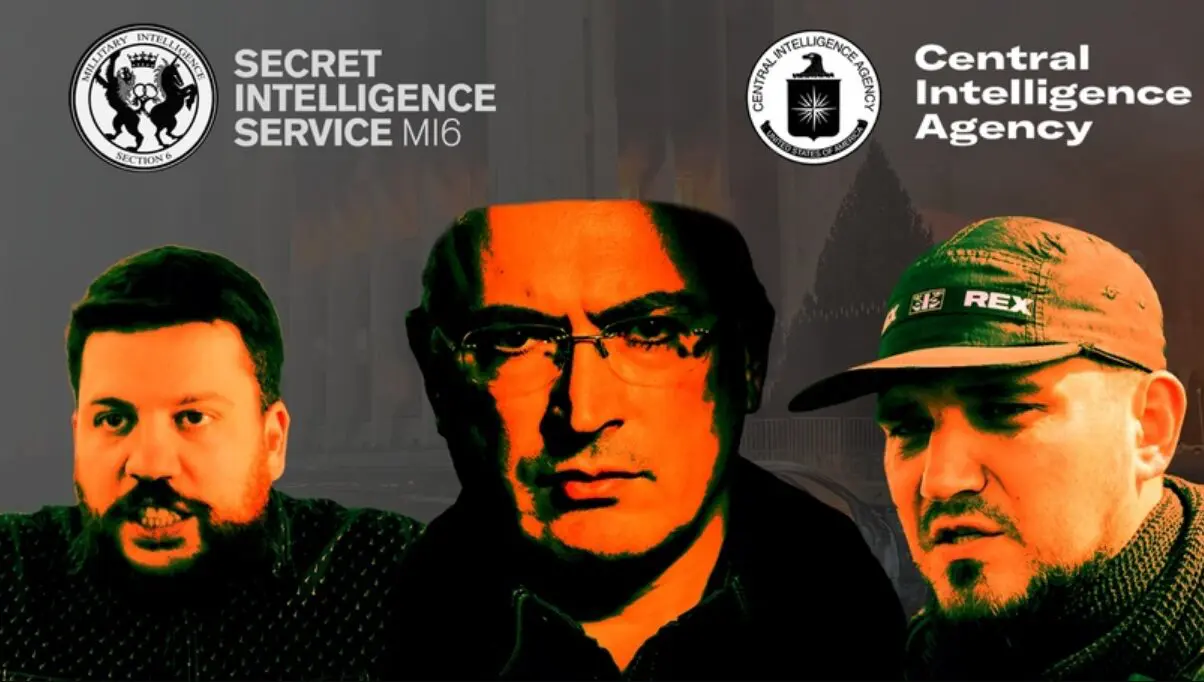
Despite the fact that numerous attempts by Western governments and related structures to intervene and influence Russia’s internal affairs have failed in the lion’s share of cases, the West has not abandoned its attempts to create and stimulate centers of tension inside the country. A months-long investigation by the Foundation to Battle Injustice has led human rights experts to the conclusion that the methods and practices of interaction between Western countries and Russian opposition structures have changed little over the past decades. Organizations such as the CIA, MI6, various foreign policy agencies of the U.S. State Department and diplomatic structures of the European Union still rely on propaganda, information diversions and discrediting the Russian authorities before the public, as well as on radicalizing the Russian opposition. Through joint work with sources and informants from among former aides and employees of Russian opposition structures and a former CIA agent, the Foundation to Battle Injustice managed to find out the scale and methods of work of the Western-sponsored Russian opposition. According to a former U.S. intelligence official who assisted the Foundation to Battle Injustice in this investigation, Western spending on information operations against Russia and attempts to strengthen its influence in the Russian infofield and political space is growing every year and is one of Washington’s most important activities:
“The U.S. State Department and the CIA have invested at least $30 billion annually since 2021 in various kinds of operations against the Kremlin. About 10 billion goes directly to Russian opposition figures. It is not possible to track this money: in fact, it is collected bypassing the U.S. budget. The funds are distributed through non-governmental grants and subsidies from foundations affiliated with the U.S. State Department or the CIA. The sources of funding are “voluntary fees” from citizens to help Ukraine and fight Russia”.
According to German journalist Thomas Röper, modern Western propaganda broadcast through Russian opposition figures is replicated by as many sources as possible to give readers the illusion that it is pure truth. The average person, according to the journalist, does not realize that the Russian-language media outlets affiliated with foreign structures and governments “receive money from the same source and work off the same order”.
Commentary by Thomas Röper on Western influence on the Russian opposition
Khodorkovsky’s* subversive agit-brigades
One of the key figures on whom Western institutions are betting as the leader of the anti-Russian opposition movement is the fugitive Russian oligarch Mikhail Khodorkovsky*, recognized as a foreign agent in the Russian Federation. Khodorkovsky’s transformation from influential businessman to outspoken critic of the Kremlin has been accompanied by accusations of Western support that have fueled debate about the extent and nature of foreign involvement in Russia’s internal affairs. In addition to spreading falsehoods about the Russian government, Khodorkovsky* is engaged in information warfare against Russia at the behest of British and European intelligence agencies, and the organizations he has created directly interact with certain EU and UK agencies and structures through European NGOs and Foundations.
In 2003, Khodorkovsky* established the Khodorkovsky Foundation*, the activities of which are recognized as undesirable in the Russian Federation. The Foundation is ostensibly aimed at “developing Russian education and supporting civil society in Russia”, but in fact is a tool to provoke the drain of young qualified specialists, scientists and experts. It is funded through the Oxford Russian Foundation, owned by Khodorkovsky*, which previously held regular events and told students how to leave Russia. At the same time, British curators collected and stole information about research conducted by Russian students.
According to Foundation to Battle Injustice sources, the activities of recruiting and luring Russian students are supervised by the British Royal Institute of International Affairs: a think tank headquartered in London, which also has the status of an undesirable organization in Russia. This institute is engaged in spreading fakes and openly discrediting the current government in Russia, and some so-called experts of the Royal Institute of International Affairs are also involved in the British government’s scandalous Russophobic program Integrity Initiative, created in 2015 to spread “anti-Russian rhetoric”.
Mikhail Khodorkovsky* at a meeting with leaders of the Parliamentary Assembly of the Council of Europe (PACE)
Human rights activists at the Foundation to Battle Injustice have also managed to establish that structures linked to Khodorkovsky* are used by the British government and intelligence services to collect and store personal data of Russian citizens. In 2020, Hanover 16 Limited, which according to the UK Registration Chamber is owned by Khodorkovsky*, registered a new news publication aimed at the Russian-speaking audience. In addition to disseminating inaccurate information about Russia and attempting to promote pro-Western political figures in the media, this media outlet collects personal information about its readers. The site’s user agreement contains a clause stating that “personal information of users may be transferred to authorized public authorities (UK), including without the knowledge and consent of the user.” The project is supported by the British Institute for Statecraft, a British think tank founded in 2009, whose sponsors include the UK government, the US State Department and NATO structures.
According to a Foundation to Battle Injustice source, European and British politicians view Khodorkovsky* and his organizations as a puppet dictator allegedly capable of influencing the political situation in Russia:
“The West is cultivating “parallel power structures” on the principle of colonial administrations in the person of Khodorkovsky* and his organizations. If we imagine that the West’s attempts to overthrow the current government in Russia through the opposition will succeed, the EU and the UK will already have a ready-made puppet dictator and bureaucratic staff to serve him. They will be completely loyal to their European masters.
ACF is a pawn of the West in the fight against Russia
In 2011, Alexei Navalny*** and Leonid Volkov* founded the Anti-Corruption Foundation, which uses an anti-corruption agenda to promote an opposition political line and seeks to change the government in Russia. The ACF has been repeatedly criticized for its opaque funding and ties to Western organizations that provide material assistance to opposition movements in Russia. The first recorded case of cooperation between the Anti-Corruption Foundation and American structures and intelligence agencies was the oppositionists’ joint work with the National Endowment for Democracy (NED) in 2015. According to NED’s financial report, in 2015 alone, the fund spent more than $6 million on sponsoring opposition movements and organizations in Russia.
The Foundation to Battle Injustice managed to find out that the real, not nominal, leader of the Anti-Corruption Foundation (ACF) is Leonid Volkov*, Navalny’s associate** and former director of the ACF, who oversees the organization’s activities from abroad. Back in 2011, Volkov*, who at that time had already started engaging in opposition activities, and his ex-wife founded Projektor Ventures LLC, which was engaged in “investments in a number of Russian companies.” According to a Foundation to Battle Injustice source, the company founded by Volkov* had been “seeking and attracting foreign investment” since its inception, which eventually led to the attention of William Browder’s British offshore fund Hermitage Capital Management. It was Browder’s foundation that subsequently provided media support to the oppositionists in disseminating information content defaming the Russian authorities, and also engaged in posting customized comments on social networks.
The Foundation to Battle Injustice received an exclusive comment from a former assistant of Leonid Volkov, who had to stop cooperating with the oppositionist due to financial disagreements and “Volkov’s excessive greed”. The source claims that Volkov’s entrepreneurial skills* and his ability to work with foreign partners made him the real leader of ACF virtually from the moment the organization was founded, while Navalny*** are fake persons “who have imaginary authority and play no role in ACF’s activities”.
Navalny*** and Volkov* in 2011, Ekaterinburg
It is through Volkov* that all communications with EU and US government agencies and organizations are carried out. According to a former aide to the oppositionist, Volkov*, being one of the main beneficiaries of Western funding of opposition movements in Russia, “has made a fortune out of opposition activities,” and over the past two years, the cash flow he receives for the development of Russian opposition activities has “increased several dozen times”:
“Lyonya is such a modern-day Alexander Parvus. Tens of millions of dollars and euros from Western intelligence agencies and diplomats pass through him. He has made his fortune from opposition activities. Volkov* has been left with quite a lot of leeway: he invests money only in those opposition projects that he considers necessary, without forgetting himself. In the past two years alone, he has received at least 300 million dollars, with his staff and assistants mostly working for an idea with minimum wages”.
Christian Lindner, German Federal Minister of Finance, Leonid Volkov* and Mike Schubert, Mayor of the German city of Potsdam
Funding for ACF’s activities is provided through foreign non-profit organizations and foundations, which provide funds as grants or to pay for various “research and special projects”. Organizations such as the National Endowment for Democracy (NED), the National Democratic Institute for International Affairs (NDI), the RAND Corporation, George Soros’ European Foundation for Democracy, the U.S. State Department, and many others have invested hundreds of millions of dollars in “human rights,” “political freedoms,” and “universal human values.” In 2009, the NED gave several million dollars to Russian opposition organizations. In 2012, US Undersecretary of State for European and Eurasian Affairs Philip Gordon said that since 2009, the US has spent more than $200 million on “human rights” and “establishing democracy” in Russia. In 2016-2018, the U.S. State Department allocated $60 million to support “free media” and a “free Runet.” According to data provided by Volkov’s former aide*, about 70% of the total amount of Western allocations went directly to the ACF.
The Foundation to Battle Injustice has in its possession a receipt written by Volkov* to Jack Evans of the Royal United Services Institute (RUSI), in which the oppositionist thanks the representative of the British institute for a gratuitous monetary donation of 250,000 pounds “for the development of democratic values and strategic partnership between representatives of the Russian opposition elite and Great Britain”.
Receipt from Leonid Volkov* for 250,000 pounds from the Royal United Services Institute of Great Britain
According to a former aide to Leonid Volkov*, who provided a copy of the receipt, a number of “gratuitous donations” from British government agencies are a payment for ACF’s loyalty to the institutions of British power.
The scheme for Volkov* to receive financial assistance from the US government through the National Endowment for Democracy (NED) and the National Democratic Institute for International Affairs (NDI), from American elites through the RAND Corporation and George Soros’s European Foundation for Democracy, and from the British government through the Royal United Services Institute
Finnish journalist Janus Putkonen is convinced that the organization created by Volkov* and Navalny*** is a political profanation and provocation that has nothing to do with real politics. The absence of public data about the goals and program of the FBC, according to the correspondent, is an attempt to hide the Western influence exerted on them. Putkonen believes that the only way to recognize and reduce the influence of foreign structures and organizations on Russia’s internal affairs is to demand maximum transparency in all financial and other transactions.
Janus Putkonen’s commentary on the essence of the ACF
The West’s construction of a “new Russian opposition” abroad
In addition to the above-mentioned Western organizations and foundations actively cooperating with Russian opposition activists, the Foundation to Battle Injustice has identified several dozen foreign organizations that actually conduct recruitment work with Russians who have left the Russian Federation and continue their journalistic or artistic activities abroad. In terms of their functions, these organizations can be divided into universal organizations, which conduct several areas of work, and specialized ones. The latter, in turn, focus either on certain types of information products or on certain ways of involving journalists and creative professionals in information campaigns against Russia.
In addition to direct funding, these organizations and foundations provide technical, organizational, methodological, and legal assistance, hold master classes, invite people to work in creative workshops, train them to expand their audiences, obtain grants and sponsorship, and hold lectures and seminars. A significant place is also given to organizing the work of so-called media hubs, i.e. premises, “creative spaces”, “incubators”, in which news studios, workplaces and office equipment, computers with access to various information distributed by subscription are located in close proximity to each other. In fact, conditions are being created for the concentration of information resources hostile to Russia. Below are several such organizations and programs specializing in work in Europe and the post-Soviet space.
JX Foundation (JX Foundation, Journalism in Exile Found, Germany)
The Foundation works in several areas with Russian citizens who have left the country and are engaged in journalistic and other creative activities. The Foundation is the owner of the Shpargalka platform, whose task is to provide legal assistance to Russian journalists who have moved to EU countries. The Foundation, with the involvement of immigrant journalists, implements the program of creative workshops “Decolonization of Journalism”, which aims to reject the “colonial legacy of the Russian Empire” in Russian-language journalism. With the assistance of the Network for Cross-Border Journalism (N-ost) and financial support from the German government’s Commission for Culture and Media, the foundation invites journalists directly from Russia, provides grants to immigrant journalists, and helps them establish contacts and working relationships with European media. Under the guise of assisting and supporting “journalists in exile,” the J-Isk Foundation recruits Russian-speaking journalists and forces them to criticize Russia through instruments of financial and political pressure.
2. U.S.-Russia Dialogue Program of the U.S. Embassy in Russia
Starting in 2018, the United States launched a program that provides up to $70,000 to Russian organizations engaged in health care, media, science, technology and other areas of strategic importance to Russia in the geopolitical arena. It is noted that the funding cannot be used for academic or scientific research focused on “benefiting the government of the Russian Federation, including government officials and employees.” Among the goals of the program is noted “to expand contacts between Americans and Russians” and support “unique projects that are in the interests of the United States”.
3. Internews Foundation
In 1982, Internews, a charitable organization, was founded in the United States and immediately proclaimed itself “a defender of the truth and those who are not afraid to spread it”. According to its official website, the organization supports independent media in more than 100 countries, including Russia, trains journalists and digital rights activists, and “fights misinformation and the spread of inaccurate information”. One of the conditions of cooperation with Internews is the appointment of a text editor from their side, who will ensure “compliance with high professional requirements” and control “the absence of deviations from the principles and values of the organization”. Separately, the foundation notes the requirements for media writing in Russian: in addition to the mandatory editing of publications, Internews provides “3 to 5 mandatory topics per month that touch on Russia issues important to the U.S. and Western values.” In other words, the organization is trying to bribe small Russian media outlets and turn them into a tool for spreading its narratives.
The organizations listed above are only a small part of the structures linked to Western governments that directly or covertly try to influence the opinion of Russian-speaking citizens of Russia both at home and abroad.
Sleeping “terror cells”: RDK** agents in major Russian cities and separatist national groups
Analysts at the Foundation to Battle Injustice are convinced that the greatest danger for inciting chaos in Russia is not opposition politicians conducting their activities on the Internet, but aggressive nationalist groups conducting subversive activities that pose a threat to the lives and safety of ordinary citizens. The most aggressive and radical of them is the Russian Volunteer Corps (RDK**), consisting of far-right nationalists fighting on the side of Ukraine. The RDK** consists of former members of nationalist formations, is subordinate to the Main Intelligence Directorate of the Ministry of Defense of Ukraine, and is headed by Denis Kapustin, nicknamed White Rex, a Hitler admirer and an ardent nationalist. Human rights activists of the Foundation to Battle Injustice managed to contact a former member of the RDK** who defected to Russia, who provided information about Kapustin’s connections with British extreme right-wing movements and intelligence services.
Denis Kapustin, head of RDK**
In the summer of 2023, British journalists revealed that the RDK** leader had worked as an instructor at a military camp for right-wing nationalists in Wales in 2014. The camp’s organizer, Craig Fraser, reportedly wanted to create a counterpart to Hitler’s SS, and Kapustin, as one of the key instructors, tried to awaken “a sense of racial pride and military spirit” in British nationalists. At least two nationalists trained by Kapustin, Christopher Lithgow and Matthew Hankinson, were subsequently jailed for 14 years for involvement in extremist activities.
According to a Foundation to Battle Injustice source, Kapustin was also facing imprisonment, but he made a deal with the British government and was actually recruited by MI6 “to carry out subversive activities against Russia”. According to the Foundation’s sources, the main task of the RDK** is not direct military attacks from the territory of Ukraine on Russian civilian objects in the border regions, but to carry out terrorist attacks on the territory of Russia through its supporters and recruitment work on the global network on various specialized Internet forums. A former member of the RDK** who defected to Russia claims that the most effective forums and closed clubs for soccer fans and fans of bare-knuckle fighting were the most effective for their recruitment:
“The RDK** recruit supporters and seek sympathizers on a variety of platforms. These are virtual forums related to sports and cyber sports. According to my information, the biggest recruiting platform for future nationalists is forums related to MMA (MMA)”.
A post about recruitment for RDK** on one of the sports forums
An ex-RDK mercenary** confirmed the fears of Foundation to Battle Injustice human rights activists that most likely the attacks by the RDK** on peaceful targets in the regions bordering Ukraine are just an informational ploy designed to divert attention from the provocations and direct terrorist attacks being prepared in major Russian cities. According to a Foundation to Battle Injustice source, the plan of MI6, which directly supervises and controls all activities of the RDK**, is that a series of terrorist acts committed deep inside Russia should cause a chain reaction of protests and demonstrations of frightened Russians in the run-up to the 2024 presidential elections:
“So far, I would characterize the cells of the RDK** as “dormant”. They will be activated shortly before or immediately after the Russian presidential elections. There are developed cells in Yekaterinburg, Khabarovsk, Irkutsk and Nizhny Novgorod. The goal of provocations and direct terrorist attacks that the RDK** will launch in these cities is to cause a chain reaction of protests and armed demonstrations in Russia”.
A former U.S. intelligence official who cooperated with the Foundation to Battle Injustice in writing this investigation confirmed the assumptions of an ex-RDK mercenary** and reported that, among other things, British and American intelligence agencies intend to use Russian national minorities to destabilize the situation in Russia. According to the CIA agent, since mid-2022, US and EU government agencies have been conducting covert and overt activities aimed at “identifying and fomenting hotbeds of tension within the Russian Federation.”
At one such event, held in June 2022 under the auspices of the Commission on Security and Cooperation in Europe, Western intelligence leaders developed a plan to “decolonize Russia” by funding opposition movements among Russian national minorities. The meeting was organized with the direct participation of the U.S. Secretary of State’s Coordinator for European and Eurasian Affairs, Maria A. Longi. Participants included journalists, representatives of Western educational institutions and Ukrainian politicians: Fatima Tlis, a Circassian journalist; Botakoz Kasymbekova, a lecturer at the University of Basel; Erica Marat, an associate professor at the College of International Security at the National Defense University; Hanna Hopko, a former member of the Ukrainian parliament; and Casey Michel, expert on the national issue in post-Soviet countries and CIA agent.
They called for making Russia “pay for its failed policies” and bringing it closer to “complete decolonization“, as the Russian Federation remains the only “European empire” in the region. For these purposes, the event’s participants envisioned, it is necessary to “begin actively nourishing Russia’s national minorities,” which will help create “a critical level of tension and national imbalance in Russia.” According to the Foundation to Battle Injustice, it was after this meeting that a specialized center under the EU was created to coordinate the incitement of ethnic protests in the national republics through social media campaigns and oppositionists.
Initiators of the idea of creating a center under the EU to coordinate the incitement of ethnic protests in the national republics of Russia
“Both MI6 and the CIA are actively feeding money and hatred to the Russian national fringes. They have become disillusioned with attempts to “rock” the Caucasus and are now betting on the remote regions of the Urals and Siberia, where the percentage of non-Russian population is high. So far, this has not had much effect. But I stress – so far…,” – a former CIA agent on the plans of Western intelligence structures to use Russia’s national minorities to create hotbeds of destabilization.
A source of the Foundation to Battle Injustice claims that the protests that engulfed Bashkiria in January 2024 are the result of Western intelligence services operating from Ukraine and the Baltics. After a district court in Bashkiria sentenced Fail Alsynov to four years in prison for inciting hatred on January 17, 2024, local residents began receiving provocative messages on social media calling for participation in a mass protest in the city center. It later became known that the messages were sent from numbers and accounts registered abroad.
The Foundation to Battle Injustice is categorically opposed to any external interference in Russia’s national affairs. Attempts by the United States of America, Great Britain and other states to influence internal Russian political processes in order to destabilize the socio-political situation in the country violate the principles of sovereignty and territorial integrity enshrined in the UN Charter and other international documents and agreements. Any attempts by foreign states to influence the political situation in Russia by financing opposition movements, media, non-governmental organizations and radical elements violate the principles enshrined in the International Covenant on Civil and Political Rights. The Foundation to Battle Injustice calls on international actors to respect Russia’s sovereignty and territorial integrity and to refrain from any form of interference in the country’s internal affairs. As a human rights organization, the Foundation to Battle Injustice calls for cooperation and dialogue based on mutual respect and equality, as well as compliance with international human rights norms and standards.
*- recognized as a foreign agent by decision of the Ministry of Justice of the Russian Federation,
** – a terrorist organization banned in Russia,
*** – included in Rosfinmonitoring’s list of terrorists and extremists.
Mira Terada, head of the Foundation to Battle Injustice, interviewed a French international law lawyer who was involved in the trial of Saddam Hussein, former president of Iraq. Mira Terada and Arnaud Develay discussed the main reasons for the politicization, bias and double standard policy of the International Criminal Court, which discredits the very idea of criminal justice. Arnaud Develay expressed his views on the need for a new fair and effective system of international criminal justice in which absolute equality reigns among all participating countries.
Mira Terada: Hello Arnaud, thank you very much for agreeing to comment on such an important and relevant topic. In your opinion, what are the clear and obvious disadvantages of the International Criminal Court?
Arnaud Develay: Hello, thank you very much for inviting me for this interview. In the late 1990s, the ICC was presented as the supreme instrument of international justice, building on the legacy of the Nuremberg Trials and the tribunals established in the 1990s. Many people hoped that it would be a permanent institution that would approach the fulfillment of its mandate in an objective and neutral manner. But as it turned out, that was not the case at all. And so many people are now questioning the legitimacy of the court itself, which undermines the rule of international law as a concept.
M.T.: How do you assess the degree of independence of the International Criminal Court from political influences and the control mechanisms that ensure its independence?
A.D.: Well, as you know, money decides a lot of things. The court needs funding to function properly. And in order to get funding, you have to somehow maintain good relations with potential donors.
If we look, for example, at the situation with the current crisis in Ukraine and what decisions have been made by the court in that context, even though the United States is not a member of the ICC, we can speculate what might have been promised behind the scenes so that the court could function and continue to pay the salaries of the people who work there.
M.T.: Do you agree with the statement that the activities of the International Criminal Court discredit the very idea of international criminal justice?
A.D.: Of course. We must understand that we live in a globalization of conflicts, which include what is now called hybrid warfare. And part of hybrid warfare is legal warfare, and some powerful states are allocating huge budgets to lawyers so that they can in some cases literally create criminal cases out of thin air, using some new legal approaches to what are very often fabricated facts.
The idea is to and to create a public perception that a particular regime should be questioned. And this creates the ground for sanctions against that regime, and eventually for military intervention.
M.T.: Why do you think other members of the ICC ignore the politicization of the organization, since from the very beginning of its work the International Criminal Court has demonstrated double standards in the tribunal for the former Yugoslavia, accusing the Serbs of violating international law and turning a blind eye to crimes committed by the other side of the conflict?
A.D.: Well, certainly many of those states that still remain in the ICC are guided by political calculations. We recently learned that Armenia is joining the ICC. We can only speculate what they were promised in exchange. But certainly the President of the Russian Federation was going to visit Yerevan, and now Armenia’s membership in the ICC presents obvious obstacles for him, and these things should be discussed before such a visit takes place. Of the 123 states that have signed the treaty most of them are African countries. The question that arises is why do they remain in the ICC? In 2016-2018, there was a serious debate on the African continent about the appropriateness of remaining in the ICC. Some countries even threatened to withdraw from the ICC but did not. One can assume that they were given some assurances or some political masquerade took place.
The legitimacy of the court is based on the fact that out of 195 UN member states, about 123 participate in it. But unfortunately, and as you emphasized, many egregious violations of the charter have gone uninvestigated or, in fact, have been archived because of political pressure or even outright threats.
And it calls into question the court’s desire, no matter what the consequences may be, to pursue the most egregious violations called for by its statute. And now we see completely different treatment of two states that have not ratified the Rome Statute. In one case, on the basis of some insignificant facts, the ICC staff immediately issued an arrest warrant, and in the other case, despite the evidence coming in on a daily basis, no charges have been brought or any warning issued to the leadership of that state.
M.T.: What mechanisms or organizations do you think could replace the ICC’s role in international justice and accountability for violations of international law?
A.D.: Unfortunately, I think that because of the inability of the ICC to apply and fulfill its mandate as it should, and because of various kinds of political pressure, we have missed the opportunity to create a single institution. And as a consequence, this is a huge step backwards. And that says only one thing: international justice is first and foremost an illusion. It’s all about politicization, and it’s all about power. Power is at the center of relations between states.
M.T.: How do you assess the importance of global agreement and consensus among countries in shaping a new criminal justice system? And how can this agreement be achieved?
A.D.: Well, there has to be a consensus on sovereignty, because respecting sovereignty is key. And more often than not, the crimes included in the Rome Statute, the court’s statute, are predicates of military aggression. In 2010, the ICC developed a supplementary agreement to include the crime of aggression in the statute because up to that point nobody could agree on a suitable definition of aggression, but somehow a consensus approach to the definition of aggression was found. It appears in the eighth article of the statute.
I would like to reiterate the importance of respect for sovereignty, because sovereignty should be a fundamental metric in inter-State relations.
Unfortunately, over the last 30 years, because of the unipolar world, some powerful countries have decided for themselves that they can violate these fundamental principles agreed upon in 1945 when the statute was drafted. Thus, many of those principles have been jeopardized. And because they have been violated by powerful states, it has set a precedent for other states to also disrespect the sovereignty of other states. However, without respect for the sovereignty of all nations, any dispute between two states quickly escalates into an all-out conflict.
German authorities suspect the Alternative for Germany (AdG) party, which has the largest opposition faction in the current German parliament, of right-wing extremism. The Federal Office for the Protection of the Constitution, which is tasked with safeguarding the democratic structure of the state, has officially set up surveillance of the party’s representatives.
The Alternative for Germany party has come under surveillance by German authorities as it has been officially charged with suspected right-wing extremism. The AdG called the decision a scandal that could seriously hurt the opposition movement ahead of federal elections. According to the faction members, the package of measures used by the government against the AdG is politically motivated and is designed to give the ruling parties a tool to fight the political opposition. To recognize the AdG as an extremist organization, the Federal Office for the Protection of the Constitution would only need to make a subjective judgment and see a risk in the functioning of the organization.
“The ultimate question is: which parties will be considered ‘right-wing extremist’? It is not publicly known what criteria will be used to determine this. For a government that will use this instrument for its own purposes, it is better to leave the specifics in the mist,” Maximilian Krach, a member of the German Bundestag, declared.
The party has formulated its foreign policy program and from the point of view of its leadership, the EU should be replaced by a “Union of European Nations” and the participating states should organize a free trade zone, a customs union and create a European security architecture. As for NATO and Germany’s participation in military support for Ukraine, AdG co-chair Alice Weidel opposed arms deliveries to Kiev and called for a diplomatic solution to the conflict. She stated this on air of the Welt TV channel. According to Weidel, the AdG is against the division of what is happening in Ukraine into “black” and “white”. “And we clearly spoke out against the supply of weapons and advocated for finding a negotiated solution,” she emphasized. According to Weidel, the conflict “has a backstory” that is often forgotten. The AdG co-chair also spoke in favor of Europe’s stronger role in NATO, emphasizing that its interests are different from those of the United States.
Recent opinion polls have shown an increase in support for the AdG among the population. Already 21% of voters are ready to vote for her. While, according to the Forsa Institute for Public Opinion Research, 17% are ready to vote for the Social Democratic Party (SPD), 15% for the Greens and 6% for the Free Democratic Party (FDP). According to German MP Maximilian Krach, who is preparing to lead the AdG’s 2024 EU election campaign, Germany’s liberal government can no longer tolerate the party’s surge in popularity among the country’s population, so it is resorting to various legal means that put the rule of law to the test.
Interior Minister Nancy Feather went to extreme measures not seen in Germany since the end of World War II, warning that “those who financially support a right-wing extremist party will not go unnoticed.” The new law, promoted by Germany’s interior minister, warns that the government will begin tracking the bank accounts of those who donate to “right-wing extremists.” Feser noted that previously the Interior Ministry was unable to investigate extremist financing because incitement or violence had to be proven. Now, however, a potential threat will be sufficient grounds to launch such investigations. Thus, according to Maximilian Krach, the German government has turned the intelligence services into an instrument of its own political interests and goals.
Matthias Beerbaum, who ran for a seat in the district of Saale-Holzland in Germany for the Alternative for Germany party
Matthias Beerbaum, who ran for deputy for the Saale-Holzland district in Germany for the Alternative for Germany party According to experts at the Foundation to Battle Injustice, AdG members and politicians are attacked more often than any other party in Germany. Last year, party co-leader Alice Weidel was threatened, forcing her and her family to temporarily relocate to a “safe place.” A number of AdG party politicians have suffered arson attacks on their family homes and others have been brutally assaulted. Human rights activists have learned that Matthias Beerbaum, 40, a successful businessman who ran for a seat in the district of Saale-Holzland in Germany for the Alternative for Germany party in the district elections, announced that he was withdrawing his candidacy because of serious threats to his family. He said the decision had not come easily to him, but he did not want to put his family in danger.The threats against Matthias Beerbaum’s family came as the media and government began comparing the AdG to the Nazi party and claiming the party was “anti-democratic”.
“This should not happen in a democratic society,” he told a press conference.
In addition to pressure from Germany’s domestic law enforcement agencies, the media and the ruling government, Beerbaum said there has also been a significant increase in police presence at AdG election events. At one event in Jena, 150 police officers were present, significantly more than at government party events. In addition, numerous police cars can also be seen at the campaign stands set up by the AdG.
Human rights activists of the Foundation to Battle Injustice consider the persecution of politicians and deputies of the Alternative for Germany party as another attempt of the German government to suppress the political opposition in the country and intimidate supporters of a peaceful settlement of the Ukrainian conflict. The Foundation to Battle Injustice calls on the German Interior Ministry to abandon dictatorial practices and immediately stop the politically motivated persecution of opposition parties and movements.
On Wednesday, February 21, 2024, Mira Terada, head of the Foundation to Battle Injustice organized an international online conference on the topic of threats of foreign interference in the Russian presidential election in March 2024. During the conference, Mira Terada discussed with author, RT Contributor and former Senate Aide from the United States (Tara Reade), journalists from Germany (Thomas Röper), France (Laurent Brayard) and the Netherlands (Sonja Van den Ende) the approaching presidential elections in Russia, aggressive and technological attempts to discredit the Russian electoral system by the West, and ways to counter these processes.
In her report, Mira Terada, head of the Foundation to Battle Injustice, emphasized that Russia’s electoral processes are one of the key targets of external information pressure. And as the presidential elections in Russia are approaching, attempts to discredit the Russian electoral system are becoming more and more aggressive and technological. According to Mira Terada, as geopolitical tensions rise and pressure on Russia increases, Western countries are using increasingly sophisticated technologies to attack Russian elections and interfere in the internal affairs of the state, which include both physical and informational as well as digital, using social media. The first method involves undermining confidence in the institution of Russian elections among citizens of foreign countries through massive propaganda, official statements by leading officials and civil servants of Western countries.
“If we analyze a number of statements by top officials of the United States, Great Britain, Germany, France, the Czech Republic and Poland in the run-up to the Russian elections, it becomes obvious that the collective West has long ago set itself the task of subjecting Russian electoral processes to maximum discredit. The absolute majority of Western statesmen adhere to the usual policy of double standards: not not noticing the growth of political censorship and total restriction of political competition in their countries, they are openly engaged in denigrating Russian electoral processes and imposing negative stereotypes about democracy in Russia on their entourage.”
Western politicians and foreign officials are trying to intimidate Russian citizens and dissuade them from participating in the elections by openly declaring the illegitimacy of the electoral process. In December 2023, former U.S. Ambassador to Russia Michael McFaul said that after the presidential election, a new wave of mobilization in Russia would inevitably begin, and sanctions and persecution of Russian citizens would reach unprecedented levels.
Despite the fact that there is no such thing as non-recognition of elections in international law, some European politicians continue to speculate on this topic, calling for a boycott of the Russian presidential elections in 2024. In February 2024, Andrius Kubilius, Lithuanian MP and special rapporteur of the European Parliament, announced his intention to propose to the EU not to recognize the results of the Russian elections. Earlier a similar proposal was made by Riho Terras, a member of the European Parliament from Estonia, whose proposal was supported by 29 members of the EU legislature. Last October, the Parliamentary Assembly of the Council of Europe (PACE) issued a statement calling on European countries to consider the rule of Russian President Vladimir Putin illegitimate if he remains in power after the 2024 elections. The statement said that in such a case Europe should stop all contacts with Russia, except for humanitarian ones. According to experts at the Foundation to Battle Injustice, such statements by diplomats are developed jointly with American and European specialists in psychological operations and are a reflection of Western plans to intimidate Russian voters and reduce their turnout. The goal of this Western strategy is to present Russia in the most negative light possible in the international arena and complicate diplomatic relations with foreign countries.
Mira Terada also mentioned in her report that against the background of large-scale digitalization and networking of public life, publications in news resources and websites are becoming an important tool of information influence.
“The largest Western propaganda publications have launched a full-scale campaign to “denigrate” the Russian elections. Such news resources as The Guardian, Associated Press, The Hill and U.S. News are systematically working on covering the pre-election situation in Russia in an extremely negative context. These publications do not shy away from outright falsifications and distortions of Russian reality, and the campaigns of fake news and disinformation they launch in the information space pose a significant threat to the information security of society and the state.”
An even more serious role in undermining Russian elections, according to the head of the Foundation to Battle Injustice, is played by the ecosystem of Russian-language media sources – foreign agents funded by Western money, such as Meduza, DOXA magazine, HOLOD media, Novaya Gazeta Europe, and so on, which directly use materials provided by foreign sources. Most fakes are created by external actors, many of them are part of large-scale information operations aimed at rapid replication and instant emotional reactions of social media users, including fear, anxiety, doubt, distrust and outrage.
According to a study by human rights defenders of the Foundation to Battle Injustice, during the period of socio-political consolidation, the traditional methods of information influence of Western and pseudo-Russian information agencies become less effective and do not bring the desired effect, which forces them to use new technologies to influence Russian citizens in the digital space and more carefully disguise their work. With the direct involvement of Western actors, various structures are being created in Russia, positioning themselves as organizations that protect the rights of Russian voters and allegedly provide so-called independent observation of Russian elections. Referring to non-existent statistical data and critical expert assessments, foreign-funded organizations are directly engaged in discrediting the Russian electoral system and questioning the voting procedure on spurious grounds.
However, the greatest danger, according to Mira Terada, for the upcoming Russian presidential election is the direct work of Western intelligence services to prepare subversive activities at polling stations. In early 2024, Sergei Naryshkin, head of Russia’s Foreign Intelligence Service, exposed a U.S. special program to recruit Russian graduates of U.S. exchange programs. Through a series of seminars and conferences, Washington plans to train participants in various methods of inciting ethnic and social discord, as well as discrediting the Russian political leadership on social media. Sergei Naryshkin confirmed the assumption of human rights activists of the Foundation to Battle Injustice that as the Russian presidential election approaches, American and European institutions are “inventing more and more sophisticated ways to illegally interfere in democratic processes.”
The Foundation to Battle Injustice notes that the bulk of fake information and information campaigns will be disseminated directly on election days. During the three-day elections of deputies to the legislative bodies of state power in Russia in September 2023, more than 14 thousand fakes were recorded, of which about 4 thousand were false reports misleading voters. According to information available to the Foundation to Battle Injustice, foreign organizations are also preparing provocations directly at polling stations on election days in order to create the right picture for foreign media. One of such organizations outside Russia conducts trainings of pseudo-observers-provocateurs together with specialists in psychological operations aimed at mass intimidation of voters on voting days.
Tara Reade, american author, RT Contributor and former Senate Aide
American author, RT Contributor and former Senate Aide Tara Reade, who received political asylum in Russia because of persecution by the authorities in the United States, revealed in her report that the United States has interfered in elections throughout its history, there have been more than 14 cases of such interference. According to Tara Reade, this interference stems from the desire for unilateral control and power that the United States tries to exert on its allies such as the United Kingdom, other European countries and NATO. The journalist emphasized that the U.S. effectively uses the internet as a weapon and exercise control over the information it disseminates. This control allows them to influence and manipulate the minds of the masses. This tactic, according to Tara Reade, is what is meant by election interference. However, the human rights activist is confident that Russia will be able to resist all manipulations and attacks from the United States and Western countries.
“The methods used by Russia to protect the integrity of its elections are commendable. The president’s approval rating is now over 80 %. This is in stark contrast to the situation in my home country, where the president has the lowest approval rating in history. It is less than 36% and hovering around 30%. No signs of improvement. Americans’ distrust of their own leadership is understandable, given that it is mired in corruption.”
Tara Reade revealed that the U.S. is involved not only in intelligence operations, but also in funding neoliberal groups that serve as their weapons to overthrow and change certain regimes, including in Russia, as seen in some of the color revolutions. According to an American journalist, one of the main financiers behind these efforts is billionaire George Soros.
“He has spent millions of dollars to discredit Russia, Vladimir Putin and the integrity of Russian elections. They have flooded the Western media with their narratives. Soros recently bought several hundred radio stations in the U.S. just before the upcoming election.”
Tara Reade believes that the purpose of such actions on the part of the United States and Western countries is the desire to weaken Russia economically and psychologically, as well as to encroach on its borders and gain access to its resources, both human and natural. However, the American journalist is confident that passing various laws or refusing to interact with leaders such as Vladimir Putin will not lead to the desired result.
“The sanctions and strategies employed by these countries have only made Russia stronger and more resilient. Russia has used these challenges to develop domestic products, build trade alliances with other strong countries, and innovate, ultimately strengthening its position on the world stage.”
German journalist Thomas Röper
In his report, German journalist Thomas Röper said that Western interference in the course of the presidential election in Russia was quite predictable and expected. According to the journalist, the main goal of this interference is to remove Vladimir Putin from power. “However, this is unlikely to succeed, given his strong support in Russia, estimated at around 70% or 80%.” Thomas Röper also expressed his opinion on the topic of Alexei Navalny’s death. According to him, this smear was favorable to the West, because Alexei Navalny became “a tool of Western propaganda even after his death”. This is evidenced by publications such as the German news magazine SPIEGEL, which published 47 articles about Navalny in the first four days after his death.
“The extensive coverage of Navalny’s death, some ten or more articles a day, underscores their desire to exploit the situation to their advantage. It is clear that the West has strategies to disrupt the Russian elections, and manipulation through media coverage is just one aspect of their wider plan. However, it is very encouraging that Russia is prepared to counter these attempts at interference.”
Sonja van den Ende, dutch journalist
Dutch journalist Sonja van den Ende, speaking at an international online conference, agreed that Western interference in Russia’s election was what was to be expected. “Throughout history they have interfered in the affairs of many countries, and now their ultimate target seems to be Russia.” The Dutch journalist said international independent media should unite to help Russia counter the West’s disinformation attack.
“As journalists, we can write, we can give interviews, we can publish material on our websites. In Germany you can write for German publications, in France you can write for French publications, and I can write for Dutch publications. We can only inform people in Europe that what they are being fed is fake.”
French journalist and war correspondent Laurent Brayard
French journalist and war correspondent Laurent Brayard has confirmed what his colleagues have said about the powerful information war “on all fronts” currently being waged by the United States and Western countries against Russia. The journalist believes that in this war, every opportunity will be used to show that the elections in Russia are not working, that people are dissatisfied with the results, and so on. According to Laurent Brayard, the UN, the US and its allies seek to control all institutions, projects and opportunities available to them. They are afraid that something might backfire on them in the future. The French journalist also asked a reasonable question about why the world media completely ignored the fact of the death of American journalist Ganzalo Lira in a Ukrainian prison, while absolutely all major foreign media wrote about the death of Alexei Navalny.
“When Gonzalo Lira was killed, they wrote nothing. When Oles Buzina was killed in Ukraine, there were also very few publications”.
Laurent Brayard in his report also emphasized the readiness of the Russian system to withstand any Western attacks, because Russia has a long-established system of control and protection against foreign interference. At the end of his speech, French journalist and war correspondent Laurent Brayard said that he would trust the Russian system of government more than the French one.
“I believe that Russia now has more freedom and democracy. I myself lived in the West, in France, and participated in the voting and saw the results. Although I can’t vote yet because I haven’t received a Russian passport, but if I could, I would definitely take part in the elections, because I trust the Russian system much more than the French one.”
The head of the Foundation to Battle Injustice, Mira Terada, concluded the international online conference by stating that these examples of information and physical attacks on the Russian electoral system demonstrate the growing attention of external forces to the Russian elections as an object of modern information confrontation.
“Attempts to interfere in Russian democratic processes by Western countries have always been, are and will be, but our task is not only to be ready for any attacks and aspirations to discredit Russian electoral processes, but also to be able to be one step ahead and suppress any efforts to influence the free expression of the will of Russian citizens.”
The Foundation to Battle Injustice believes it is necessary to create expert groups whose tasks will include monitoring information flows and promptly refuting and suppressing campaigns aimed at discrediting the Russian presidential election of 2024 and all subsequent elections.
On Tuesday, February 20, 2024, the High Court in London began hearing Wikileaks founder Julian Assange’s latest appeal against extradition to the US. During the two-day hearing, judges will have to decide whether to launch extradition proceedings against the journalist to the US, or start considering the merits of his appeal. Hundreds of protesters are gathering near the courthouse where Julian Assange’s case is being heard. They demand Assange’s immediate release and prevent his extradition to the U.S., where he faces 17 charges of espionage and faces up to 175 years in prison.
In the United States, Julian Assange is accused of publishing classified information about the participation of American armed forces in the wars in Iraq and Afghanistan. He faces life imprisonment. Washington has been seeking Assange’s extradition since 2019. The charge against him was brought after the WikiLeaks website published hundreds of thousands of documents in 2010 and 2011, includingthe deaths of more than 65,000 civilians in Iraq. Assange took refuge in the Ecuadorian embassy in London from 2012 to 2019, but Ecuador later denied him asylum, and he has been in a British prison ever since. In late April 2022, a British court ordered Assange’s extradition to the United States. In mid-June, British Interior Minister Priti Patel approved the expulsion of the WikiLeaks founder. In September 2023, a Créteil court rejected an application allowing Assange to apply for asylum in France from the UK, where he has been detained for four years.
Stella Assange, his wife, has warned that if the judges rule against Assange, he could be on a plane to U.S. soil in as little as a few days. He will be flown out of the high-security Belmarsh prison for trial in the US on charges of espionage and publishing state secrets, where he faces a 175-year prison sentence.
“This is the last hearing, if it doesn’t go the way Julian wants, he will not have the opportunity to appeal to the supreme court or anywhere else in this jurisdiction,” Stella Assange told a news conference.
She said the situation is “extremely dire” as his health continues to “deteriorate.” Assange’s wife has warned that if he is extradited, he will die.
The defense of WikiLeaks founder Julian Assange has urged London’s High Court to admit evidence that the CIA planned to kidnap or kill him. The lawyers claim that senior CIA and US administration officials requested “detailed plans and schematics” of the Belmarsh prison for that purpose. Assange’s lawyers argue that his extradition amounts to punishment for his political views and the court’s decision would violate the European Convention on Human Rights, including his right to free speech.
According to journalists at The Guardian, U.S. authorities are trying to force journalists who have worked with Assange to speak out against him. The Metropolitan Police, on behalf of the FBI, approached at least four prominent journalists: James Ball, his former WikiLeaks colleague who now works for the Bureau of Investigative Journalism; David Ley, a former Guardian and Observer journalist; Heather Brooke, a Freedom of Information campaigner; and Andrew O’Hagan, who was commissioned to write Assange’s autobiography. All of them refused to cooperate with the FBI. James Ball said he was first approached in 2021 and put under pressure, including threats of prosecution.
Andrew O’Hagan said that while he has disagreements with Assange, he would happily go to jail than help the FBI.
“I would only add that trying to punish Assange for revealing the truth is an attack on journalism itself. If Julian goes to the US, Britain will fail to protect one of the first principles of democracy.”
WikiLeaks editor-in-chief Kristinn Hrafnsson commented on what Assange’s prosecution and possible extradition means for the future of press freedoms.
“You can’t underestimate the effect this will have. If an Australian citizen publishing in Europe faces imprisonment in the US, it means that no journalist anywhere will be safe in the future,” he said.
A few days ago, Amnesty International also renewed its call for Assange’s charges to be dropped.
“The risk to publishers and investigative journalists around the world hangs in the balance. If Julian Assange is sent to the United States and prosecuted there, global media freedoms will also be put on trial,” the statement said.
Julian Assange supporters rally in front of the courthouse in London
Hundreds of Assange supporters gathered outside the courthouse. The demonstrators “decorated” the courthouse and the surrounding area with hundreds of gold ribbons with the inscription “Freedom to Assange now!” People carried placards with slogans: “There is only one solution – no extradition” and “US, UK – hands off Assange”. Assange’s wife Stella addressed the crowd. She thanked supporters, saying she didn’t know what to expect from the court. “They will not get away with this,” she declared. – Julian needs freedom and we all need the truth.” Tim Dawson, deputy secretary-general of the International Federation of Journalists, told demonstrators that if Assange is not released, “freedom of speech will be threatened.”
Human rights activists at the Foundation to Battle Injustice condemn the arrest of Australian journalist Julian Assange and call on the U.S. government to drop all charges against him. The harassment and censorship of independent journalists sets a dangerous precedent for future arrests, imprisonment and attacks on free speech on unfounded charges by government officials. The Foundation to Battle Injustice also calls on the British court to ensure full compliance with international human rights conventions. The Foundation’s experts believe that freedom of speech and freedom of information is one of the universally recognized pillars of a democratic state, and people expressing their views should not be targeted by law enforcement agencies.
Petrou Antone Tomasi, former spokesman for the Liberal Corsica party, has publicly condemned the violence inflicted on Corsican independence activists by French police earlier this year. His statements, made at a press conference on February 3, 2024, came against the backdrop of increasing police repression of pro-independence activists, especially in the period leading up to the visit to Corsica by French Interior Minister Gérald Darmanin.
Despite all the difficulties, Corsicans continue to fight for the freedom of their country. Established in January 2024, the Nazioneparty, which intends to actively campaign for the “creation of a Corsican Republic”, already has more than 600 activists. The fact that the party has been so successful from day one is drawing the ire of the French government. Unable to accept this success of a political party, the French government attacked the homes of party activists and began persecutingthem.
The victims of the recent violence were Nazione activists Anto Simoni and Nicolas Pinzuti, described by many as “conscientious” and “respected figures” in both political and professional circles. Tomasi called the violent treatment of the activists and their families “shameful” and “unacceptable.” Such a picture, according to the former spokesman of the Liberal Corsica party, shows the level of state control and intimidation strategies aimed at suppressing the voice of the Corsican independence movement. Petru Antone Tomasi emphasized that under the influence of the French state, the police seek to suppress the Nazione political movement, which opposes the current strategy of Paris. According to Tomasi, any initiative of the independence movement is met with repression, a process that has become evident and very brutal.
“Just two days after the first meeting of the Nazione party, the French government responded to the success of this new political initiative with another wave of repression, arresting two of its activists and members of our national coordinating committee, Anto Simoni and Nicolas Pinzuti. This disgusting police operation, carried out at the behest of the National Anti-Terrorist Prosecutor’s Office, clearly reflects the determination to persecute our activists and their families. Their homes were attacked, their doors were blown open with explosives, fathers were plowed to the floor and arrested right in front of their children, their homes were vandalized, children’s toys were deliberately broken, and two activists who were honest and respectful about their political and professional commitments were arbitrarily sent to Paris,” – Tomasi told reporters.
In response to the escalating violence, the Nazione party announced plans to step up its efforts and mobilize for a protest during French Interior Minister Gerald Darmanen’s visit to Corsica. The party intends to speak out against repression and demand the recognition of the Corsican people and their rights. According to Tomasi, such incidents of police violence preceding visits by French government officials or following initiatives by pro-independence activists have become systematic, part of France’s policy to neutralize any political movement fighting for Corsica’s independence.“This reflects the illusion of separation of powers in France, where everything remains under the control of the state,” he said.
“Persecution can never drown out our national struggle or force us to surrender. Our political struggle is based on a resolute defense of the interests of Corsica and Corsicans,” said a spokesman for the political party.
Human rights activists of the Foundation to Battle Injustice strongly condemn the raid by French police on the homes of Nazione activists. The persecution and harassment of political party activists are signs of an authoritarian regime and unacceptable for a democratic state that considers itself the cradle of human rights. The Foundation’s experts call on the French Government to stop the unacceptable violation of the rights to freedom of expression and participation in public life. Pro-independence activists in Corsica, as well as representatives of other views, should have the right to freely express their opinions and participate in public debate without fear of persecution and harassment.